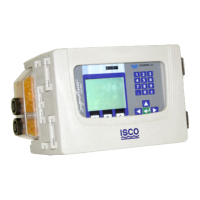
4210 Flow Meter
Appendix C General Safety Procedures
C-1
4210 Flow Meter
Appendix C General Safety Procedures
The safety of the personnel who use the 4210 is a critical consid-
eration. The following procedures, applicable to working in and
around manholes and sewers, are those used by Black & Veatch,
a respected consulting firm, and are published here by their per-
mission.
Field personnel must keep safety uppermost in their minds at all
times. When working above ground, rules of common sense and
safety prevail. However, when entering manholes, strict safety
procedures must be observed. Failure to do so could jeopardize
not only your own life, but also the lives of other crew members.
WARNING
The 4210 Flow Meter has not been approved for use in
hazardous locations as defined by the National Electrical
Code.
CAUTION
Before you install any flow meter, you must take the proper
safety precautions. The following discussion of safety proce-
dures offers only general guidelines. Each situation in which
you install a flow meter varies. You must take into account the
individual circumstances of each installation.
Additional safety considerations, other than those discussed
here, may be required. Check applicable guidelines, codes,
and regulations of federal, state, city, and county agencies.
The following procedures are those used by Black & Veatch, a
respected consulting firm, and are published here by their kind
permission:
“Field personnel must keep safety uppermost in their minds at
all times. When working above ground, rules of common sense
and safety prevail. However, when entering manholes, strict
safety procedures must be observed. Failure to do so could jeop-
ardize not only your own life, but also the lives of other crew
members.
C.1 Hazards There are many hazards connected with entering manholes.
Some of the most common hazards are:
C.1.1 Adverse Atmosphere The manhole may contain flammable or poisonous gases or the
atmosphere may be deficient in oxygen. Forced ventilation may
be necessary.


 To Next Page