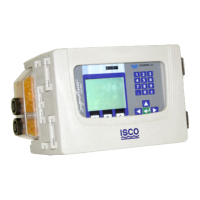
4210 Flow Meter
Section 1 Introduction
1-12
1.9 How to Make Battery
Calculations
To calculate battery life expectancy for an installation, you must
know two things:
•The capacity of the battery you are using
•The average current draw of the flow meter or (other
device) powered
Battery capacity is expressed in ampere-hours. The battery
manufacturer provides this information for each battery. This
value is the product of a load current times an arbitrary time
period, ten hours for nickel-cadmium batteries, and twenty hours
for lead-acid types. The terminal voltage of the battery at the end
of this time period is the discharged cell voltage, 10 volts for
nickel-cadmium and 10.5 volts for lead-acid types. Note that bat-
teries are fully discharged well before the terminal voltage drops
to zero volts.
Isco batteries are rated at 4 ampere-hours for the
nickel-cadmium and 6.5 ampere-hours for lead-acid types.
Convert the battery current capacity into milliamperes and then
divide this figure by the average current drawn by the unit. This
will give you a number in hours. Divide that figure by 24, and
you will have the number of days.
The published ampere-hour figures do not mean that you can
expect to draw 4 amperes from the nickel-cadmium battery (or
6.5 amperes from the lead-acid battery) for one hour. At the
one-hour rate, discharges are typically less than half the ten- or
twenty-hour rate.
To convert ampere-hours to milliamperes, multiply by 1,000.
Examples:
4 ampere-hours × 1,000 = 4,000 mAh
6.5 ampere-hours × 1,000 = 6,500 mAh
If you divide this figure by the average current of the flow meter,
say 15 mA, you will have:
4,000 ÷ 15 = 266.67 hours
Divide this number by twenty-four to get days:
266.67 hours ÷ 24 = 11.1 days
For considerations of safety, we suggest you subtract 10% from
this number (100% – 5% for 95% capacity and 5% for a reserve at
the end of discharge).
11.1 – 1.1 = 10 days
This is the battery expectancy for a nickel-cadmium battery with
a 15 mA continuous average drain, with a 10% derating factor.
You can use the same method to calculate for lead-acid batteries,
except the current will be 6,500 mA, and the period correspond-
ingly longer, in this case a little over 16 days. You can run the full
number of days calculated without derating if your batteries are
new and at 100% capacity, but you will leave yourself no safety
factor if you are in error on either of these assumptions.
Remember, if the battery fails, there will be a period of time
during which no measurements will be taken, (and no data
stored, if you are also using FLOWLINK® software).


 To Next Page