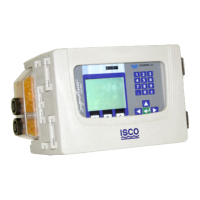
4210 Flow Meter
Section 1 Introduction
1-3
•Ultrasonic Sunshade
•Calibration Target
•Cable Clamp
•Floor Mount
1.4 Operating Principles The 4210 normally measures flow rate with a primary measuring
device (weir or flume) or other open-channel flow arrangement
where there is a known relationship between liquid level and
flow rate. The 4210 can also measure flow in round pipes by
using the Manning equation. The level-sensing device is an
ultrasonic transducer. The flow meter electronically converts the
level reading into a properly scaled flow rate. The flow meter also
provides standard or optional flow-related output signals to be
used for:
• Flow-proportional sampler pacing
• Transmitting level and flow data to an external device
on a serial communication loop
• Data transfer through a modem
• Control of a 4 - 20 mA device
• Data transfer by a laptop computer
The flow meter contains a microprocessor that calculates level
and flow rates from the signals produced by the ultrasonic level
sensor, stores programming instructions and operates the
display and internal printer. An alphanumeric liquid crystal
display (LCD) shows total flow, level, and flow-rate. It also
assists in programming the flow meter during initial set up or
subsequent changes. An internal printer provides a “hard copy”
printout of the information computed by the flow meter, plots
level or flow rate, and generates reports. Connectors for other
equipment used with the 4210 are on the side of the case.
1.5 The Ultrasonic Level
Sensor
The ultrasonic level sensor (USLS) mounts directly over the flow
stream. The flow meter measures level by transmitting an ultra-
sonic pulse toward the liquid surface and then measuring the
time it takes for the echo to return. The ultrasonic level sensor
consists of an enclosure with a single transducer acting both as
pulse transmitter and echo receiver. Since the speed of the pulse
through the air varies with temperature, compensation is
built-in. A temperature sensor inside the enclosure measures
ambient temperature. The microprocessor program automati-
cally compensates for speed-of-sound changes caused by air-tem-
perature changes.
1.5.1 Transducer Operation Several times a second, the ultrasonic level sensor emits a pulse.
Between pulses the transducer becomes a receiver or micro-
phone, ready to sense the echo reflected from the surface of the
liquid. When the transducer receives the echo, the sound energy
changes into a small electrical pulse, that is amplified and
detected by the flow meter to produce an echo-received signal.


 To Next Page