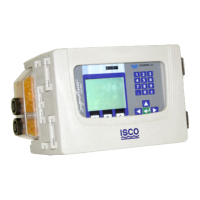
4210 Flow Meter
Section 3 Installation
3-9
Ultrasonic Floor Mount – The Ultrasonic Floor Mount is a col-
lapsible metal stand that you set up at the bottom of a manhole
over a flow stream. This device provides a stable mounting for
the level sensor for temporary or permanent installations.
Ultrasonic Cable Straightener – The cable straightener is
designed for use in installations where the transducer is sus-
pended by its cable only, such as from the Spreader Bar. The
straightener helps hold the transducer vertically plumb, thereby
stabilizing alignment.
Ultrasonic Calibration Target – This option is designed to
make calibration of the level sensor more accurate during the
installation process by letting you calibrate the level sensor from
outside the manhole.
Ultrasonic Sunshade – The ultrasonic sunshade is a white
plastic cap that fits over the top of the ultrasonic transducer. Its
purpose is to keep sunlight from heating the body of the level
transducer and introducing temperature errors to the internal
temperature compensation.
Extension Cable – Isco offers a 25 foot (7.6 m) extension cable
to connect to the ultrasonic level sensor. Do not attempt to cut or
splice cable lengths. Coil any extra cable neatly by the flow
meter. The level sensor is supplied with a 25 foot cable, so with
the extension you can mount the level sensor as far as 50 foot
(15.2 m) from the flow meter. Other lengths of cable can be
ordered, up to 1,000 feet, but this is a custom product. For special
lengths of cable, consult the factory. The maximum distance
between the level sensor and the flow meter is 1,000 feet.
3.6 Ultrasonic Level
Sensor: Mounting
Considerations
The location of the ultrasonic level sensor depends on the method
of level-to-flow rate conversion you are using. The 4210 is usually
installed with some type of primary measuring device, such as a
weir or flume. The location of the ultrasonic level sensor over the
primary device depends on the type of primary device used. Most
primary devices have a specific place intended for the head
(level) measurement device. For example, the head measuring
point of a weir is at least three times the expected maximum
head upstream from the weir plate. For Parshall flumes, the
measuring point is
1
⁄ 3 of the way into the converging section. For
Palmer-Bowlus flumes, the measuring point is at least
1
⁄ 2 pipe
diameter upstream from the entrance to the flume. Refer to the
Isco Open Channel Flow Measurement Handbook or to infor-
mation provided by the manufacturer of the primary device for
more details about the location of the head measuring point.
3.6.1 Mounting Location If you intend to measure flow by some other means, such as a
gravity flow equation (Manning) or by calibrating a section of the
flow channel, you will have to determine the location of the ultra-
sonic level sensor. You should base this location on the hydraulic
characteristics of the site and the method of level-to-flow rate
conversion used.


 To Next Page