4210 Flow Meter
Section 1 Introduction
1-4
The time between the transmitted pulse and echo-received signal
is proportional to the distance between the transducer and the
liquid surface. This distance determines the liquid level.
1.5.2 Validity Tests and Error
Display
The flow meter checks the measured level for validity. If it cannot
obtain a valid level, it will repeat the process. If the flow meter
cannot obtain a valid reading after about one minute the level
reading will drop to zero with an asterisk (*) to indicate there is
an error.
1.5.3 Ambient Air
Temperature Factor
The ultrasonic measurement technique used in the 4210 Flow
Meter is based on the speed of sound in air.
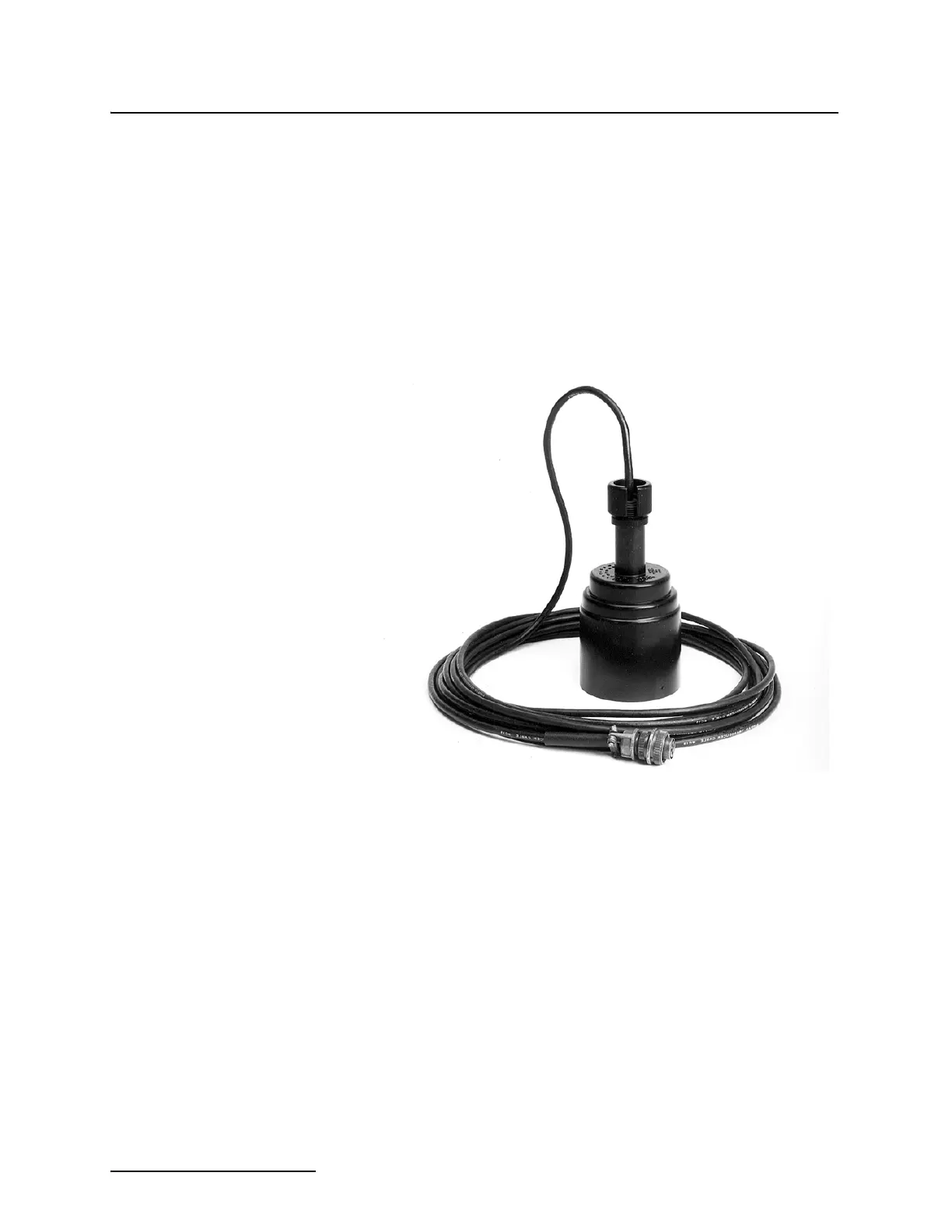
Figure 1-2 3012 Ultrasonic Level Sensor
Since the speed of sound in air varies with temperature (approxi-
mately 1% for 10° variation), compensation must be provided.
The ultrasonic level sensor uses both air temperature and micro-
processor-based compensation to accurately account for air tem-
perature variations.
1.5.4 Return Echo Amplifier
Compensation
The strength of the echo depends on several factors, including
the distance between the transducer and the water surface. For
every 2
1
/2 foot increase in the distance between the transducer
and the liquid surface, the strength of the returned echo
decreases by half. Consequently, the flow meter must com-
pensate the gain of the return echo amplifier for distance. As the
distance increases between the transducer and the liquid
surface, the gain of the echo amplifier increases with time to
compensate for the decreasing signal strength of the echo. This


 To Next Page