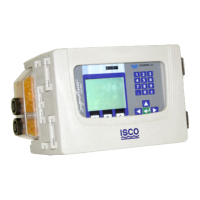
4210 Flow Meter
Section 5 Maintenance and Service
5-6
2. Take hold of one of the spools and rotate it slightly, loosen-
ing the ribbon.
3. Lift gently until the spool comes free from its shaft. Do the
same with the other spool.
4. Lift the chart and take-up spool out of the way and remove
the ink ribbon from the printer mechanism, noting how it
threads through the unit.
5. Thread the new ink ribbon through the printer mecha-
nism.
6. Locate the three small pins on each spool of the ink ribbon
and turn the spools so the pins face the gears on the two
ribbon shafts.
7. Replace the two spools on their respective shafts, pushing
the detector levers out of the way so the spools will easily
re-engage their gears.
8. Gently rotate each spool to tighten the ink ribbon. Rein-
stall the paper take-up roll if necessary.
5.2.3 Do Not Lubricate or
Disassemble
It is not necessary to provide any periodic lubrication to the
internal printer mechanism in the 4210 Flow Meter. The internal
printer mechanism has been designed for long life and
trouble-free service without special maintenance, if it is not sub-
jected to abuse. Isco recommends no attempt be made to oil or
disassemble the mechanism should it malfunction. Oil attracts
dirt; some oils become gummy over a period of time and may
cause parts of the mechanism to bind or stick. Attempts to disas-
semble the internal printer mechanism may cause the frame or
component parts to be bent or distorted. This will certainly cause
malfunction. Do not force any part of the mechanism with tools
or probes. Other than the roll of paper and the ink ribbon, the
internal printer mechanism contains no user-serviceable parts.
Isco recommends the unit be returned to the factory for service
should this become necessary.
5.3 Isco Software Updates
5.3.1 Flash Memory and the
UPDATE Disk
Many Isco instruments use a type of memory called a Flash
EPROM. Unlike earlier EPROMs that require UV erasure and
were not easily field-replaced, the Flash EPROM lets you
upgrade the software in the instrument without opening the unit
or returning it to the factory.
The disk contains UPDATE, a small DOS program specifically
for Flash memories, and a set of software files to update the
Flash EPROM. The disk may also contain file(s) with a “.txt”
extension that provide release information about the software
files.
The disk is labeled with:
• The instrument series number
• The software revision number for each instrument in
the series


 To Next Page