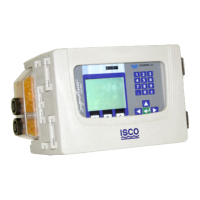
4210 Flow Meter
Section 5 Maintenance and Service
5-13
3. Check the battery or power supply.
Proper voltage to the unit should be from 10.5 to 14.5 VDC.
If the unit is powered from the AC supply, make sure the
branch circuit is delivering at least 110 VAC to the power
supply cord.
4. Check the wiring harnesses, connectors, and solder joints.
Under normal conditions these should stay in good condi-
tion. However, abuse, or operation of the unit with the door
open or the desiccator saturated could cause corrosion of
the connectors in certain atmospheres.
5. Look for physical damage.
Burned or broken components, overly hot components,
stuck or inoperative switches, or the evidence of water
damage.
6. Look for shorted or open diodes and transistors, especially
driver transistors.
7. Check the voltage regulators.
The output voltage from the regulators should be within
5% of their rated value. Check to see that rated voltages
are available at various places on the boards.
8. Look for excessive current draw from some or all the cir-
cuitry.
This will usually be accompanied by an unusual amount of
heat coming from some component or group of components,
and the voltage on the power rails may be depressed.
9. Check the input signals to unit and see that they are cor-
rect.
This will require the use of an oscilloscope. Consult Techni-
cal Service for the appearance of wave forms.
10. Check to see that the crystal oscillator is operating and at
the proper frequency.
11. Check the reset circuitry to see that it is working properly.
5.5 Precautions for
Servicing CMOS
Circuitry
Most of the circuitry in the 4210 Flow Meter is made up of CMOS
components. Because of the oxide gate structure of these devices,
they are extremely susceptible to destruction caused by the dis-
charge of static electricity through their inputs. Note that many
of the driver transistors in the 4210 are power MOS devices; they
are susceptible to static damage just as CMOS ICs are. Because
of this risk, certain precautions must be taken when working on
these circuits.
5.5.1 Hazard of Static
Electricity
The voltage levels present from static buildup due to walking
over carpeted floors, movement of woolen or synthetic clothes
over chair seats, workbenches, etc., are high enough to destroy
CMOS circuitry when performing repair work. Ideally, all tools,
soldering irons, etc., should be grounded, and work should be
conducted on a grounded metal workbench, with grounding
straps worn on the wrists of personnel. It is recognized that in
most field repair situations, such precautions are impractical.
However, certain extreme hazards must be avoided.


 To Next Page