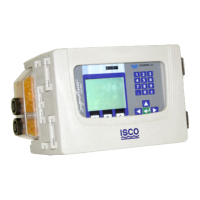
4210 Flow Meter
Appendix C General Safety Procedures
C-5
“People in good health are not afraid to drive over the high
passes in the Rocky Mountains. At Loveland Pass, oxygen
pressure is 13.2% of a normal atmosphere. At the top of Mt.
Whitney, oxygen is equal to 12.2%t. Many hikers go there, and to
higher peaks as well. After adequate acclimation, they may climb
to the top of Mt. Everest, where oxygen is equal to only 6.7%.
“The lowest oxygen concentrations that I have observed in a
sewer atmosphere was 13 percent. It was in a sealed chamber,
near sea level, upstream from an inverted siphon on a metro-
politan trunk. A man would be foolish to enter the chamber.
Without ventilation, he might die, but not from lack of oxygen.
“It seems unlikely that anyone has ever died in a sewer from suf-
focation, that is, a lack of oxygen. Deaths have often been
attributed to ‘asphyxiation.’ This is a word which, according to
the dictionary, is used to mean death from an atmosphere that
does not support life. The word has sometimes been misinter-
preted as meaning suffocation, which is only one kind of asphyxi-
ation.
“In nearly all cases of death in sewers, the real killer is hydrogen
sulfide. It is important that this fact be recognized. Many cities
diligently test for explosive gases, which is very important, and
they may measure the oxygen concentration which usually is
unimportant, but they rarely measure H
2
S. Death has occurred
where it is unlikely that there was any measurable reduction in
the oxygen concentration. Waste water containing 2 mg per liter
of dissolved sulfide, and at a pH of 7.0, can produce, in a chamber
with high turbulence, a concentration of 300 PPM H
2
S, in the air.
This is considered to be a lethal concentration. Many people have
died from H
2
S, not only in sewers and industries, but also from
swamps and from hot springs. In one resort area, at least five
persons died from H
2
S poisoning before the people were ready to
admit that H
2
S is not a therapeutic agent. Hardly a year passes
in the US. without a sewer fatality from H
2
S as well as deaths
elsewhere in the world.
“The presence of H
2
S in a sewer atmosphere is easily deter-
mined. A bellows-and-ampoule type of tester is very satisfactory
for the purpose, even though it is only crudely quantitative.
When using a tester of this type, do not bring the air to the
ampoule by way of a tube, as this may change the H
2
S concen-
tration. Hang the ampoule in the air to be tested, with a suction
tube to the bulb or bellows.
“Lead acetate paper is very useful as a qualitative indicator. It
cannot be used to estimate the amount of sulfide, but it will
quickly turn black in an atmosphere containing only a tenth of a
lethal concentration.
“Electrodes or other similar electrical indicating devices for H
2
S
in air have been marketed. Some of them are known to be unre-
liable, and we know of none that have proved dependable. Do not
use one unless you check it at frequent intervals against air con-
taining known H
2
S concentrations. A supposed safety device that
is unreliable is worse than none at all.


 To Next Page