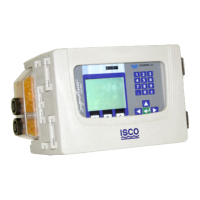
4210 Flow Meter
Section 3 Installation
3-7
Beam Angle – The flow meter must only respond to surfaces
within a specific area. The transducer can only “see” items inside
a cone whose apex (point) is the ultrasonic transducer. The beam
angle is the angle across this cone. If the beam angle is too wide,
the flow meter will detect unwanted surfaces, such as the walls
of the channel. If the beam angle is too narrow, setup of the
installation is difficult and the flow meter may never detect an
echo. The 4210 uses a beam angle of 8°.
Humidity – The velocity of sound varies only slightly with
humidity (maximum 0.35% at 68° F). Because the effect is small,
the 4210 does not provide any compensation for humidity.
Humidity, however, does have an effect on the reduction of the
sound. Under conditions of extremely high or low humidity, the
reduction of the sound wave may be inconsistent with the charac-
teristics of the ramp-gain amplifier. This can cause an echo
detect error.
Noise – Background noise can interfere with the operation of the
flow meter. You must filter this noise out, or the flow meter may
trigger on noise rather than the echo. The 4210 uses a tuned
circuit to filter unwanted noise outside the operating frequency.
Noise in the operating frequency range (around 40 kHz) can
render the system unstable. Software algorithms eliminate most
sporadic noise pulses occurring within the flow meter's operating
frequency range.
Surface Objects – Objects or foam floating on the surface of the
flow stream can absorb or weaken the ultrasonic pulses. If the
pulses are reduced enough there will be no echo. In less severe
cases, the flow meter may experience an echo detection error.
Temperature – The velocity of sound at a given temperature
may be approximated by the following equation:
...Where Velocity is in feet per second and Temperature is in
degrees F.
Temperature changes have a significant effect on the velocity of
sound (approximately 7% between 32° and 104° F). Conse-
quently, the 4210 provides temperature compensation. There is a
temperature sensor embedded in the housing of the ultrasonic
level sensor. However, the temperature of the transducer, level
sensor, and air may not be exactly the same, and the temper-
ature sensor cannot measure temperature perfectly. As a result,
the equations used to calculate the velocity of sound in air are
approximations, including the equation shown above.
Waves – Waves on the surface of the flow stream can deflect the
sound energy so it does not return to the transducer. Waves can
also cause the sound to return to the transducer by an indirect
path. In the first case, the flow meter will not receive an echo; in
the second case, the additional time lapse will cause an echo
error, indicated by an incorrect level reading. The 4210 employs a
Velocity 1050 1 Temperature459.67+()×=


 To Next Page