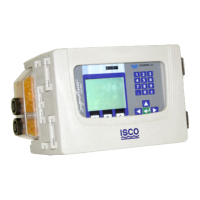
4210 Flow Meter
Appendix C General Safety Procedures
C-7
Carbon
Dioxide
CO
2
Asphyxiant, Colorless,
odorless. When
breathed in large
quantities, may cause
acid taste. Non-flam-
mable. Not generally
present in dangerous
amounts unless an
oxygen deficiency
exists.
1.53 Cannot be endured at
10% more than a few
minutes, even if sub-
ject is at rest and oxy-
gen content is normal.
Acts on respiratory
nerves.
40,000
to
60,000
5,000 — — At bottom;
when heated
may stratify
at points
above bottom.
Products of
combustion,
sewer gas,
sludge. Also
issues from car-
bonaceous
strata.
Oxygen
deficiency
indicator
Carbon
Monoxide
CO Chemical asphyxiant.
Colorless, odorless,
tasteless.
Flammable.
Poisonous.
0.97 Combines with hemo-
globin of blood.
Unconsciousness in 30
min. at 0.2% to 0.25%.
Fatal in 4 hours at
0.1%. Headache in few
hours at 0.02%.
400 50 12.5 74.0 Near top, espe-
cially if present
with illuminat-
ing gas.
Manufactured
gas, flue gas,
products of
combustion,
motor exhausts.
Fires of almost
any kind.
CO ampoules.
Carbon
Te tr a -C h l
oride
CCl
4
Heavy, ethereal odor. 5.3 Intestinal upset, loss of
consciousness, possi-
ble renal damage, res-
piratory failure.
1,000
to
1,500
100 — — At bottom. Industrial
wastes,
solvent, cleaning
Detectable odor
at low concen-
trations.
Chlorine Cl
2
Irritant. Yellow-green
color. Choking odor
detectable in very low
concentrations.
Non-flammable.
2.49 Irritates respiratory
tract. Kills most ani-
mals in a very short
time at 0.1%.
4 1 — — At bottom. Chlorine cylin-
der and feed line
leaks.
Detectable odor
at low concen-
trations.
Formal-
dehyde
CH
2
O Colorless, pungent suf-
focating odor.
1.07 Irritating to the nose. — 10 7.0 73.0 Near bottom. Incomplete
combustion of
organics. Com-
mon air pollut-
ant, fungicide.
Detectable odor.
Gasoline C
5
H
12
to
C
9
H
20
Volatile solvent.
Colorless. Odor notice-
able at 0.03%. Flam-
mable.
3.0
to
4.0
Anesthetic effects
when inhaled. Rapidly
fatal at 2.4%. Danger-
ous for short exposure
at 1.1 to 2.2%.
4,000
to
7,000
1,000 1.3 6.0 At bottom. Service stations,
garages, storage
tanks, houses.
1. Combustible
gas indicator.
2. Oxygen
deficiency
indicator.**
Hydrogen H
2
Simple asphyxiant.
Colorless, odorless,
tasteless. Flammable
0.07 Acts mechanically to
deprive tissues of oxy-
gen. Does not support
life.
— — 4.0 74.0 At top. Manufactured
gas, sludge
digestion tank
gas, electrolysis
of water. Rarely
from rock strata.
Combustible gas
indicator.
Hydrogen
Cyanide
HCN Faint odor of bitter
almonds.
Colorless gas
0.93 Slight symptoms
appear upon exposure
to 0.002% to 0.004%.
0.3% rapidly fatal.
— 10 6.0 40.0 Near top. Insecticide and
rodenticide.
Detector tube
Gas Chemical
Formula
Common
Properties
Specific
Gravity or
Vapor
Density
Air = 1
Physiological
Effect*
Max
Safe
60 Min.
Exposure
ppm
Max.
Safe
8 Hour
Exposure
ppm
Explosive
Range
(% by vol.
in air.)
Limits
lower/upper
Likely
Location
of
Highest
Concentration
Most
Common
Sources
Simplest and
Cheapest
Safe Method
of Testing
Hydro-
gen Sul-
fide
H
2
S Irritant and poisonous
volatile compound.
Rotten egg odor in
small concentrations.
Exposure for 2 to 15
min. at 0.01% impairs
sense of smell. Odor
not evident at high
concentrations. Color-
less. Flammable.
1.19 Impairs sense of smell,
rapidly as concentra-
tion increases. Death
in few minutes at 0.2%.
Exposure to 0.07 to
0.1% rapidly causes
acute poisoning. Para-
lyzes respiratory cen-
ter.
200
to
300
20 4.3
45.0
Near bottom,
but may be
above bottom
if air is heated
and highly
humid.
Coal gas, petro-
leum, sewer gas.
Fumes from
blasting under
some condi-
tions.
Sludge gas.
1. H
2
S Ampoule.
2. 5% by weight
lead acetate
solution.
Table C-1 Hazardous Gases (Continued)


 To Next Page