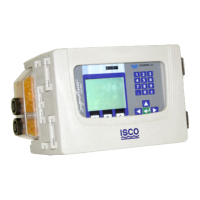
4210 Flow Meter
Section 2 Programming
2-6
A primary measuring device is a structure placed in a flow
stream through which the entire stream must flow. These devices
are made in a number of styles and sizes, but they all have one
thing in common: For any type of primary measuring device
there is a known relationship between the level in the flow
stream ahead of the device and flow rate through the device.
Consequently, after you measure level with the flow meter, it can
calculate flow rate and total flow from the measured level, by
consulting built-in look-up tables.
Detailed information about many commonly-used primary mea-
suring devices is provided in the Isco Open Channel Flow Mea-
surement Handbook. This useful book provides formulas, flow
rates at various levels, and values for maximum head, as well as
much interesting descriptive material. This book is available
from Isco, upon request, with each flow meter. If your instal-
lation uses a nonstandard primary device, you should consult the
manufacturer of the device for flow rates at given levels. The flow
meter will then calculate a flow conversion for such a device on
the basis of the manufacturers' data you enter as data points or
an equation. In some instances, a nonstandard primary device
could be supplied with a flow equation; you can enter that
equation into the flow meter and the flow meter will calculate the
flow rate from that equation.
Flow Calculations Without Primary Devices
It is not always necessary to have a primary measuring device.
The 4210 Flow Meter can measure level and calculate flow
without having any primary device installed in the flow stream.
Sometimes the shape of the flow stream itself forms the primary
device. The Manning formula uses the shape of a pipe or
channel and its slope to calculate flow in open (non-pressurized)
pipe situations.
The conversion types available are WEIR/FLUME, MANNING,
DATA POINTS, and EQUATION.
Use a Weir/Flume flow conversion when your primary measuring
device is a weir or a flume. A weir is a wall or dam across the
flow stream. Water must rise to the point where it flows over the
top of the wall. The measured level upstream behind the wall is
used to calculate the flow rate. Flumes differ from weirs in that
there is no wall or barrier, but instead a restriction, typically a
sharp narrowing or change in the slope of the channel that
restricts the flow. Again, the measured level of the stream at
some point ahead of the restriction is used by the flow meter to
calculate flow. In this flow conversion mode, the flow meter uses
internal look-up tables for many common primary measuring
devices.
An Equation – is used when you have a non-standard primary
device, or want to use different values from those programmed
into the look-up tables of the flow meter. Equation flow con-
version uses the standard flow equation:
Q = k1HP1+ k2HP2


 To Next Page