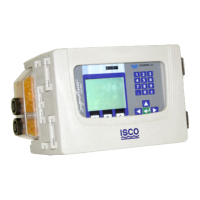
4210 Flow Meter
Section 3 Installation
3-15
approximate order of their significance. Factors affecting
accuracy of the ultrasonic technique were discussed in the
beginning of this section.
Avoid Temperature Differences – Avoid installations where
the ultrasonic level sensor will operate at a different temper-
ature than the air between the level sensor and the flow stream
through which the ultrasonic beam passes. The reason is that the
temperature sensor mounted in the ultrasonic level sensor is
intended to provide the flow meter with temperature readings
taken from the surrounding air. If the ultrasonic level sensor
operates at a different temperature than the surrounding air, the
flow meter's temperature compensation will be based on the tem-
perature of the level sensor rather than the surrounding air. This
will lead to significant errors.
Use a Sunshade in Outdoor Applications – This situation is
most likely to occur where the ultrasonic level sensor is installed
outside and is directly exposed to the sun. In such installations, a
sunshade should be provided to keep the sun from shining
directly on the level sensor, as sunlight will raise the temper-
ature of the level sensor's housing significantly higher than the
surrounding air temperature.
Serious Errors Possible – Errors caused by the ultrasonic
level sensor operating at a different temperature than the
ambient can be quite serious. For example, with a distance of
only two feet and a temperature difference of 35° F, the level
error is:
(about 1 inch)
Temperature differences between the ultrasonic level sensor and
the flow stream surface will lead to velocity errors because the
ultrasonic level sensor is at a different temperature than the air.
Also, air layers of different temperatures between the level
sensor and the flow stream surface will cause an abnormal
reduction in the strength of the ultrasonic pulse. (The flow meter
is designed to interpret the normal pulse correctly, not an
abnormal one.) This may lead the flow meter to detect the wrong
wave and introduce a wave detect error.
Avoid Wind Currents – As much as possible, the ultrasonic
level sensor should be installed in a location protected from air
currents. Wind reduces the strength of the ultrasonic pulse and
echo. This causes the flow meter to have difficulty detecting the
proper wave in the echo, resulting in a wave detect error. In
severe cases, it is possible for the flow meter to lose the echo com-
pletely.
Avoid Excessive Distances – Although the ultrasonic level
sensor cannot be mounted closer than two feet from the
maximum level of the flow stream, it is recommended that the
mounting be kept as close to the twelve inch limit as possible.
The reason is that the error made by the flow meter in calcu-
LevelError 0.001 35× 2× 0.070foot==


 To Next Page