dV-DOSC dV-SUB Manual V3.0 June 2005 131
Connect all enclosures to the AMP RACKS using appropriate cables and adaptors (SP and DO2W or
DO plus DOFILL) and SP.7 jumpers between enclosures for parallel operation. Long cable runs should
be dressed and tied off to dV-BUMP for strain relief. Be careful not to connect more than 3 dV-DOSC
enclosures in parallel. Conduct a final inspection to make sure all cabling is correct, proper inter-
enclosure angles have been selected and that all dV-PINs are in place and securely seated.
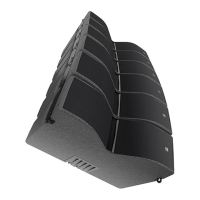
Connect the front and rear motors (or single motor) to dV-BUMP. Slowly begin to raise the array. As
the array lifts off, the rear gaps between dV-DOSC #1 to #2 and then between blocks of 3 cabinets
will automatically close, allowing you to progressively pin the blocks together as system goes up.
Be careful to steady the array as it lifts off the ground in order to prevent it from swinging. Gradually
lift the array until it is freely floating in air. For single point hangs, use a digital inclinometer to verify
that the tilt angle of the top enclosure is correct before taking the array up to trim.
Procedure 2 (larger configurations)
For larger configurations it is best to follow the dV-SUB standalone rigging procedure (see above) and
then fly dV-DOSC in blocks of 3 underneath the pre-flown dV-SUB array.
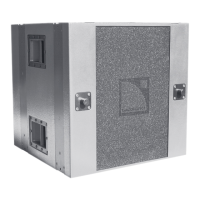
The first dV-SUB enclosure is located at the rigging location and flipped onto it's stacking runners in
the normal orientation. Four dV-ANGLESD are pre-attached to the dV-SUB using 4 x dV-PIN25, in
preparation for attaching dV-BUMP. The ''fat'' part of the dV-ANGLESD is oriented towards the
center of dV-SUB on both sides and since there are no stacking runners on the top of dV-SUB, it is
possible to select the stacked hole position on the dV-SUB end of dV-ANGLESD. The dV-BUMP is
then placed in position and secured using 4 x dV-PIN25.
The chain motor is attached to dV-BUMP using an 18 mm shackle and the first dV-SUB enclosure is
raised off the ground with sufficient clearance to position the next dV-SUB enclosure underneath.
4 x dV-ANGLESS are pre-attached to the second dV-SUB enclosure (using 4 x dV-PIN25) and the first
dV-SUB is slowly lowered into position by mating the pre-attached dV-ANGLESS to the
corresponding rigging slots on the first enclosure. The two dV-SUBs are secured using 4 x dV-PIN25
and this procedure is repeated as the dV-SUB array is progressively flown.
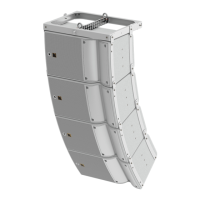
Blocks of 3 dV-DOSC are then pre-assembled using the angles calculated in ARRAY2004 or
SOUNDVISION. These blocks are then flipped out of their flight cases onto dV-SUB dolleys in order
to position them under the dV-SUB array. Using dV-ANGLESD and dV-ANGLESDP for attachment of
the first dV-DOSC, the dV-SUB array is lowered into position so that the front points can be attached.
The system is then lifted and the first block of 3 dV-DOSC is raised/rotated into position and pinned at
the rear. This procedure is then repeated for subsequent blocks of 3 dV-DOSC.
Table 21: EXAMPLE PICK POINT REFERENCE CHART
(2 dV-SUB, 6 dV-DOSC, 7.5 deg between all dV-DOSC)
dV-BUMP Hole #
(0=front, 16=rear)
1-> 8 = center
9 -> 16 = ext bar
dV-BUMP Site Angle
(= top dV-DOSC site angle
provided 3.75 deg selected between
top dV-DOSC and dV-SUB)
1 +9.5 deg
2 +7.8 deg
3 +5.9 deg
4 +4.1 deg
5 +2.0 deg
6 0 deg
7 -1.9 deg
8 -4.1 deg



 To Next Page