dV-DOSC dV-SUB Manual V3.0 June 2005 87
The benefits of flown subwoofers include:
• Improved low frequency summation, impact and throw.
• Improved time alignment since the physical path length difference problem of ground stacked
subwoofers versus flown dV-DOSC is no longer an issue. Overall, this improves low frequency
summation and coherency.
• Elimination of local low frequency buildup for the audience down front in the first few rows.
Adding several ground stacked subwoofers per side or a centre position will provide sufficient low
end impact for the first 15-20 metres (see Section 3.4.3).
• Cleaner staging and better audience sightlines.
For smaller systems, dV-DOSC is normally flown under dV-SUBs (for example 6+2, Fig 65a) and for
larger systems, dV-SUBs are flown beside the dV-DOSC array (for example 12+4, Fig 65b). As
alternatives to Fig. 65b, dV-SUB arrays can also be flown behind the dV-DOSC array or in a coplanar
configuration (see Fig. 69).
The stacked system pictured in Fig 65c works well for club and theatre applications since this
configuration provides good throw and underbalcony penetration. For theatrical sound reinforcement,
a hybrid approach is often adopted with a flown balcony system (Fig 65a) used in conjunction with a
stacked floor system (Fig 65c).
Alternatively, the dV-BUMP2 accessory allows dV-DOSC to be stacked on top of the bumper to
provide balcony coverage and dV-DOSC flown underneath dV-SUBs to provide floor coverage (Fig
65e). In this case, the two dV-DOSC arrays individually provide balcony and floor coverage while both
benefit from the low frequency energy provided by dV-SUBs.
Note: For hybrid stacked/flown systems (as seen in Fig. 65e), the trim height of the system should be
selected so that the bottom cabinet of the stacked dV-DOSC system has a zero degree site angle and is at
the same height as the listening level for the first row of the balcony audience. This helps avoid reflections
from the balcony face while providing more even off-axis coverage for the first row of the balcony.
As shown in Fig 65d, when subs are stacked in a column below dV-DOSC with minimum physical
separation, extended vertical pattern control is obtained at low frequencies. Improved coupling is
obtained since there is almost no discontinuity in low frequency radiation from the top of the array to
the ground. This configuration is recommended for flat, open air applications since extended vertical
pattern control and coherent coupling provides improved low frequency throw.
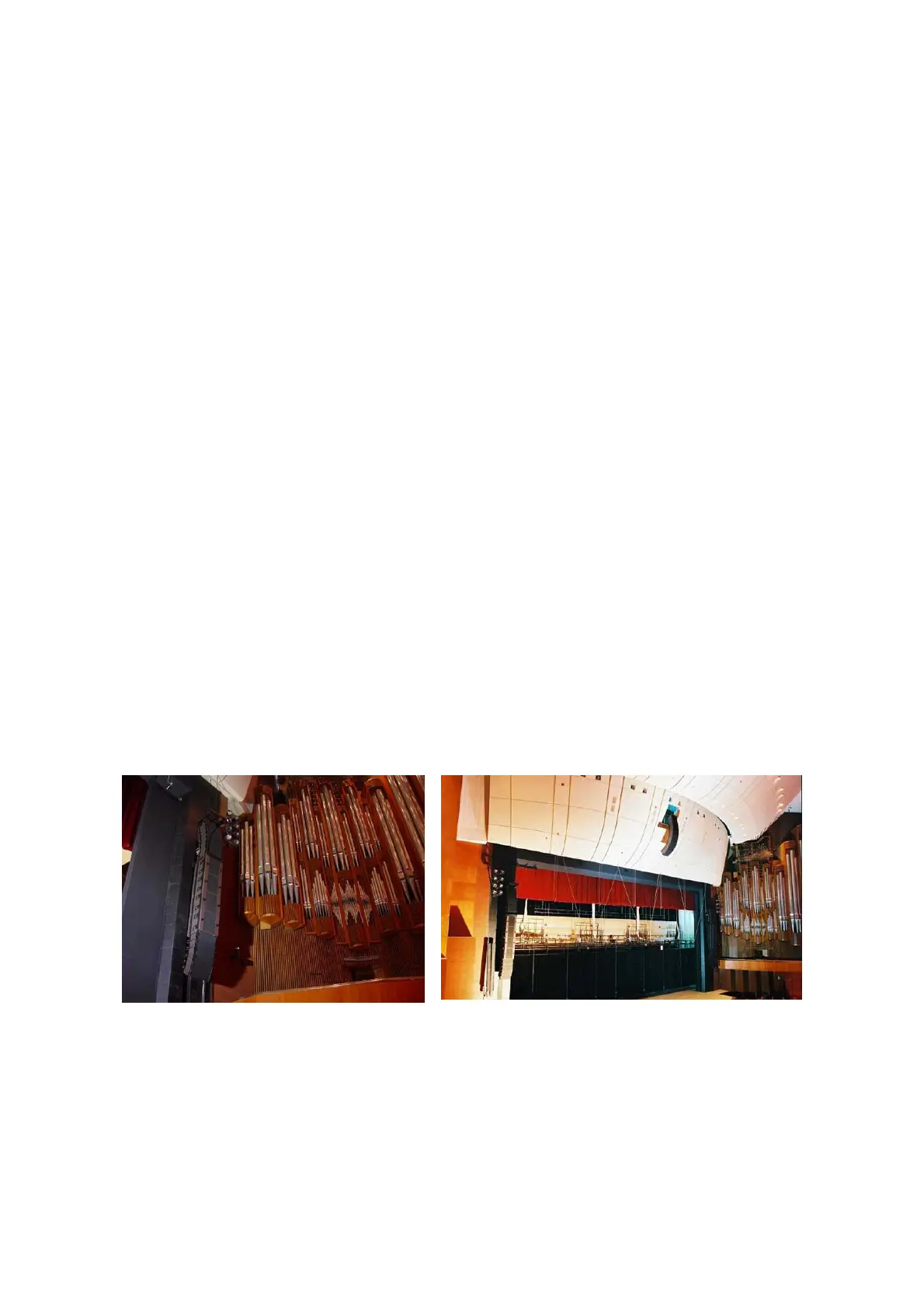
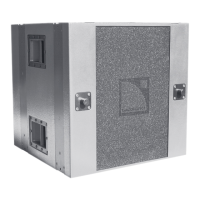
Figure 66: Hybrid stacked/flown dV-DOSC/dV-SUB arrays and centre cluster (Saejong Cultural Centre, Seoul,
Korea fixed installation – note: custom rigging employed. Sound design: Dream Sound)



 To Next Page