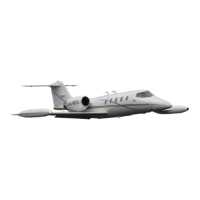
Leerjet 35/36 Developed for Training Purposes 4A-7
February 2007
Avionics
Altimeter
FC-200 autopilot only without Rosemont probe: the pilot’s
encoding altimeter system consists of an encoding altimeter, an
altitude alerter, and a static defect correction (SDC) module.
The pilot’s encoding altimeter is a servo-driven counter/pointer
display that follows an input from the SDC module when in Nor-
mal mode. When in Standby mode, the altimeter reverts to an
uncorrected servo-driven altimeter.
The SDC module measures pitot and static pressures and pro-
vides static pressure correction for the pilot’s encoding altime-
ter.
The copilot's altimeter is a conventional, barometric (servo-
driven) indicator that uses static pressure to indicate aircraft
altitude.
Vertical Speed Indicators
FC-200 autopilot without Rosemont probe: two vertical
speed indicators show vertical velocity, up or down, from 0 to
6,000 fpm.
On early aircraft, the pilot’s altimeter drives the single pointer,
rate of climb indicator. Output from the altimeter is amplified
and demodulated to operate a torque motor in the indicator that
drives the indicator pointer through gearing. In later aircraft, an
instantaneous vertical speed indicator (IVSI) is used.
The copilot’s vertical speed indicator uses pressure differential
to show vertical velocity.
Clock
The Learjet 35/36 has a standard eight-day clock with a 12-
hour dial on the left panel.
As an option, a Davtron 811B multifunctional digital clock can
be installed on the right panel.


 To Next Page