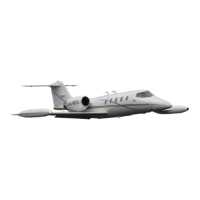
Leerjet 35/36 Developed for Training Purposes 4A-15
February 2007
Avionics
Directional Gyros
The directional gyros are in shock-mounted racks in the nose
compartment. They provide a full 360° of heading information.
The directional gyros provide inputs to the RMI, autopilot, HSIs,
and flight directors.
Vertical Gyros
Two JET VG-206D vertical gyros in the nose compartment pro-
vide 360° of roll information and ±85° of pitch information to the
attitude and flight director indicators.
Radio Altimeter
A single radio altimeter on the pilot’s panel provides a precise
indication of altitude from zero to 2,500 ft. The system consists
of an indicator, transceiver, and dual antennas. Continuous alti-
tude output signals are provided to the pilot’s and copilot’s flight
director indicator and the radio altimeter.
Ground Proximity Warning System
Some Learjet 35/36 aircraft have a ground proximity warning
system (GPWS) installed to warn the crew of possible terrain
danger. The system receives navigation data from the encod-
ing altimeter, radio altimeter, navigation receiver, nose wheel,
flaps and air data computer. This data, compared against pre-
set data in the GPWS, provides visual and aural warnings to
the crew.
TCAS
Some Learjet 35/36 aircraft have a Traffic Alert and Collision
Avoidance System (TCAS) installed. The TCAS monitors the
airspace around its ownaircraft by interrogating “intruder” tran-
sponders in a radius of approximately 40nm. The TCAS utilizes
this information to provide traffic alerts and resolution adviso-
ries to the pilot.


 To Next Page