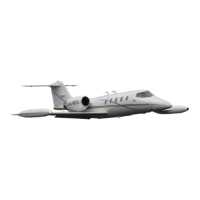
Leerjet 35/36 Developed for Training Purposes 4E-5
February 1998
Flight Controls
Fore and aft movement of the trim switch on the control wheels
while depressing the ARM button provides nose-up or nose-
down movement of the stabilizer actuator. An indicator on the
center pedestal, labeled PITCH TRIM, shows the position of
horizontal stabilizer trim in degrees nose-up or nose-down or
the position of the horizontal stabilizer itself in degrees; on air-
craft (S/Ns 35-146 and subsequent; 36-036 and subse-
quent), the indicator has the T.O. TRIM position (5-7.6×)
markings. Depressing the wheel master switch stops the pri-
mary trim and disengages the autopilot and yaw damper.
Aircraft with the FC-530 autopilot have a two-speed primary
trim system. The primary trim operates at slow speed with the
flaps retracted and at high speed with the flaps extended
beyond 3×.
The trim-in-motion audio “clicker” sounds with all trim inputs
(i.e., horizontal stabilizer movement) when the flaps are
retracted above the 3× flap switch. Depressing the wheel mas-
ter switch stops or interrupts all pitch trim or servo inputs (i.e.,
primary and secondary trim, autopilot, stick pusher/puller).
Mach Trim
The Mach trim system provides automatic pitch trim compensa-
tion when the aircraft is operated at airspeeds in the range of
0.694 to 0.83 Mach.
The Mach trim computer is temporarily bypassed if the pilot
elects to manually trim the aircraft, and a synchronous standby
mode is maintained if the autopilot is engaged.
A MACH TRIM warning light indicates a system failure and acti
vates the 0.74 Mach warning horn switch when the autopilot is
not engaged.


 To Next Page