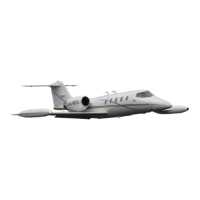
Leerjet 35/36 Developed for Training Purposes 4H-7
February 1998
Ice and Rain Protection
Ice and Rain Protection
Anti-icing protection is provided for the:
Q
wing leading edges
Q
horizontal stabilizer leading edges
Q
engine inlet and Pt2/Tt2 probe
Q
pitot tubes, static ports, and stall warning vanes
Q
windshield
Q
total temperature probe (if installed).
Wing and Horizontal Stabilizer Leading
Edges
When the STAB WING HEAT switch is in the on position, 28V
DC from the Right Main bus powers open the normally closed
pressure regulator shutoff valve. Hot bleed air from the bleed
air manifold, at approximately 16 PSI, flows through the open
valve to the wing and horizontal stabilizer leading edge diffuser
tubes. After warming the leading edges, bleed air exhausts
overboard through scuppers underneath the wing and through
the horizontal stabilizer tips.
Temperature sensors in the wing leading edge and horizontal
stabilizer transmit a signal to the temperature indicators and
thermoswitches located in the right wing and left horizontal sta-
bilizer leading edge areas provide the inputs for the WING OV
HT and STAB OV HT annunciators.
The indicator scales are divided into three zones: red, green,
and yellow. Red indicates temperatures below 35×F where
icing is possible or a failure of the anti-icing system. Green
denotes temperatures above 35×F or normal system operation.
Yellow indicates a system overheat or malfunction. The WING
OV HT and STAB OV HT annunciators illuminate if tempera-
ture in the associated leading edge area reaches 215×F
(102×C).


 To Next Page