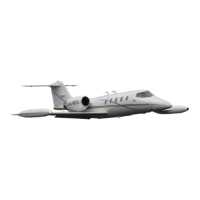
Leerjet 35/36 Developed for Training Purposes 4I-7
February 1998
Landing Gear and Brakes
Landing Gear and Brakes
The aircraft has a tricycle-type landing gear with a single wheel
nose gear and dual wheel main landing gear. A chined nose-
wheel tire deflects slush and rain away from the engine intakes.
Each landing gear strut is an air/oil type that absorbs taxi and
landing shocks. Normally, hydraulic pressure retracts and
extends the landing gear. If the normal system fails, an emer-
gency air bottle supplies pressurized nitrogen to pneumatically
blow the gear down.
On the ground, an electrically powered nosewheel steering
system positions the nosewheel in response to rudder pedal
movement.
The main landing gear has hydraulically operated disc brakes
with electrically operated anti-skid protection. The anti-skid sys-
tem provides maximum braking efficiency on all runway sur-
faces while minimizing wheel skid.
Landing Gear
Squat switches on the main landing gear actuate with weigh-
ton-wheels, completing a circuit that prevents the landing gear
selector valve from energizing to the up position. This ener-
gizes the squat switch relay panel which supplies an air/on
ground indication to the following:
Q
cabin pressurization and temperature control systems
Q
autopilot
Q
generator load limit system
Q
spoilers/spoilerons
Q
windshield anti-icing
Q
nosewheel steering
Q
Mach trim and overspeed/stick puller test
Q
hour meter
Q
air data computer (FC-530 autopilot)
Q
yaw damper (FC-530 autopilot)
Q
thrust reverser (if installed)


 To Next Page