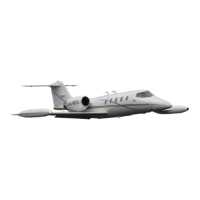
Leerjet 35/36 Developed for Training Purposes 4J-3
February 1998
Oxygen System
Oxygen System
A typical oxygen system installation consists of a single 38
cubic foot cylinder in the nose compartment or in the dorsal fin.
An optional long range system adds two 76 cubic foot cylinders
in the baggage compartment. There is also an optional installa-
tion that has a 38 cubic foot cylinder in the nose compartment
and a 38 cubic foot cylinder in the vertical stabilizer dorsal fin.
A fully serviced system should read between 1,550 and 1,850
PSI on the direct reading cockpit gage. If cylinder pressure
exceeds approximately 2,500 PSI, the oxygen cylinder pres-
sure relief valve opens to release cylinder contents overboard.
A contents discharge dislodges the green burst disc located on
the right side of the nose or right side of the dorsal fin. Mainte-
nance is required before flight if the disc is dislodged.
Distribution
Oxygen flows under pressure from the oxygen cylinder(s)
through the cylinder’s pressure regulator and shutoff valve. The
regulator reduces normal cylinder pressure to approximately 60
to 80 PSI before it reaches the crew and passenger oxygen
distribution systems.
After oxygen flows through the pressure regulator and shutoff
valve, it then flows directly to the pilot and co pilot mask outlets.
Oxygen flow to the passenger distribution system first flows
through a manually operated shutoff (PASS OXY) valve, alti-
tude controlled oxygen solenoid valve, and the manual bypass
(PASS MASK) valve. Placing the PASS OXY knob in the OFF
position isolates the passenger oxygen system from the oxy-
gen supply.


 To Next Page