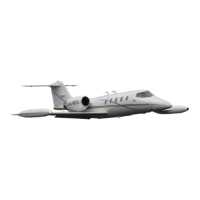
Leerjet 35/36 Developed for Training Purposes 4K-5
February 1998
Powerplant
Powerplant
Two Garrett TFE731-2-2B turbofan engines power the Learjet
35/36 aircraft. At sea level on a standard day, each engine pro-
duces 3,500 lbs of static thrust. The engine has a bypass ratio
of approximately 2.8 to 1.0. Each engine consists of:
Q
geared single-stage fan (N1)
Q
four-stage axial flow low pressure compressor (N1)
Q
single-stage centrifugal high pressure compressor (N2)
Q
annular combustion chamber
Q
single-stage axial flow high pressure (HP) turbine (N2)
Q
three-stage axial flow low pressure (LP) turbine (N1)
Ten chromel-alumel thermocouples extending into the gas path
between the HP and LP turbines measure the interstage tur-
bine temperature (ITT) and provide ITT data to the electronic
engine control (EEC) and the turbine temperature gauge.
Lubrication
The engine-driven oil pump’s pressure element draws from the
reservoir and provides it to the oil cooler under pressure
through a pressure regulator and filter. The pressure regulator
maintains oil pressure at approximately 42 PSI. The filter
includes a bypass valve that opens at 30 to 40 PSID across the
filter. Filter bypass is indicated by a red pop-out pin forward of
the filter housing on the engine.
After flowing through the filter, oil passes through the three sec-
tion air/oil cooler in the engine’s bypass duct. A temperature-
controlled bypass valve regulates oil temperature by controlling
oil flow through the cooler. At an oil temperature below 65°C
(149×F), the oil bypasses the cooler. As oil temperature
increases to 65×C, the bypass valve opens to route oil through
the coolers. If the air/oil cooler clogs, the spring-loaded bypass
valve opens to allow oil to bypass the air/oil cooler.


 To Next Page