32
Pellerin Milnor Corporation
• For a drive with more than one belt:
– Replace all of the belts together.
– Do not mix new and used belts.
– Do not mix belts from more than one manufacturer.
CAUTION: Risk of damage — A screwdriver or metal tool can cause damage to the
belt.
� Do not push the belt on with a tool.
Condition of Belts
BNUUUM02.C07 0000274604 A.4 A.2 2/4/20 8:08 AM Released
Slippage when the pulley turns more quickly than the belt can move
Slippage occurs if belts are not aligned (see Section ) or by incorrect tension explained in Section
. Slippage can cause belts to become too hot. Belts must not have a temperature more than than
140F (60° C).
TIP: The belt storage area must be cool and dry with no sun light.
TIP: New and used belts can look the same. These belts will have different strength
properties and a small difference in length.
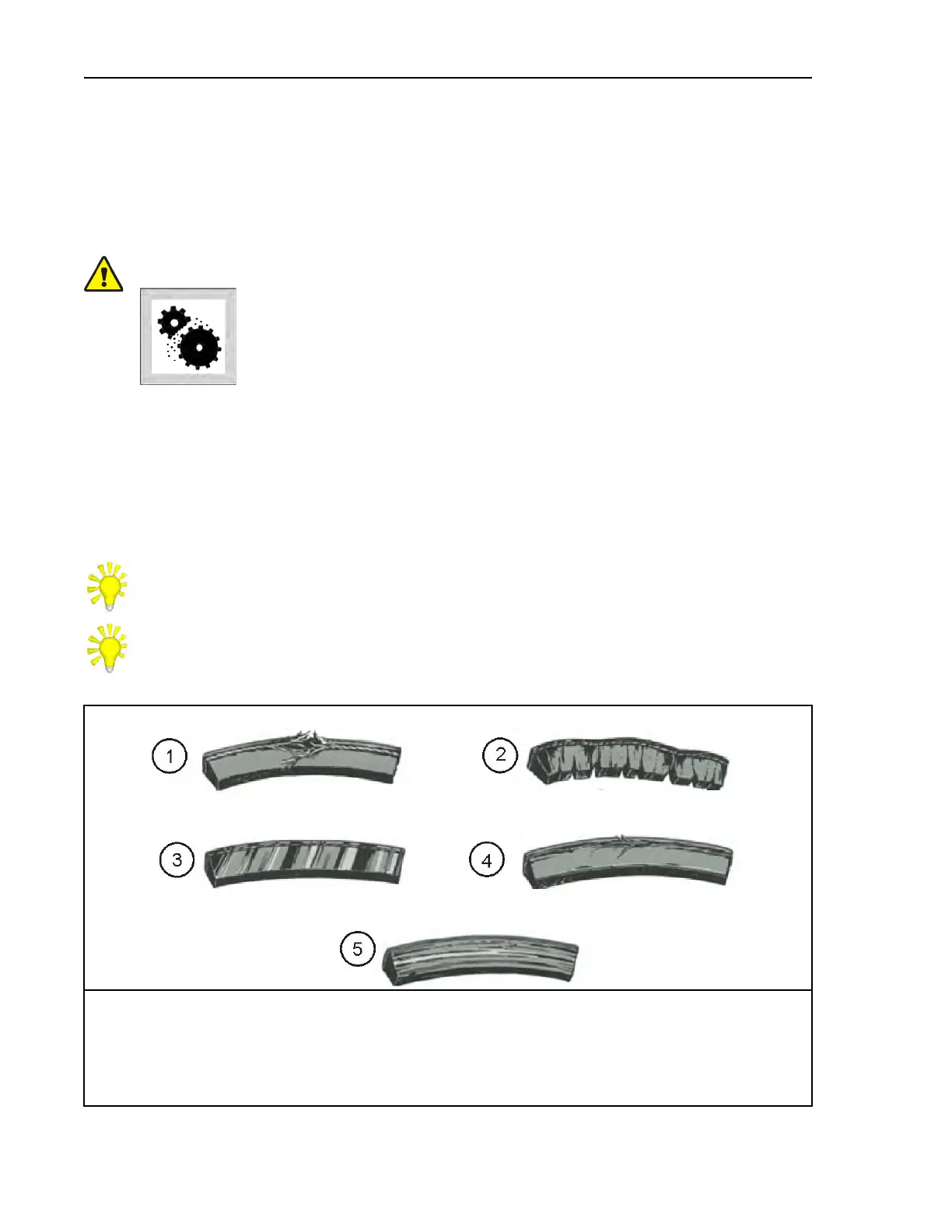
Figure 12. Types of Belt Damage
What to Look For
Legend
1. Broken cord—The belt was pushed across the groove with a metal tool.
2. Cracks—The belt is too large for the pulley.
3. Shiny sidewalls—slippage, oil, grease.
4. The belt layers disconnect—oil, grease.
5. Bands on sidewalls—rough surface or particles in the pulley groove.
Drive Assemblies





 To Next Page