User Preventative Maintenance Introduction Preventative Maintenance
5 - 2 0070-10-0556-02 Spectrum
®
/Spectrum OR
™
Service Manual
5.2 User Preventative Maintenance Introduction
This section of the manual outlines routine user maintenance guidelines.
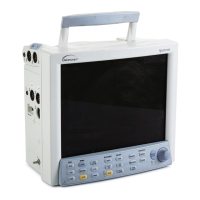
The Spectrum
®
/Spectrum OR
™
Monitor is designed for stable operation over long
periods of time. Under normal circumstances the monitor should not require technical
maintenance beyond that described in this section. However, routine maintenance,
calibration and safety checks are recommended at least once a year or more often as
required by local statutory or hospital administration practice.
5.3 Care and Cleaning of the Monitor
The monitor enclosure may be cleaned with a mild soap and water solution or ammoniated
window cleaner. Apply cleaning solution to the cloth, not directly onto the monitor. DO NOT
apply large amounts of liquid. DO NOT use abrasive cleaning agents or organic solvents.
WARNING: Do not clean the monitor while it is on and/or plugged in.
To prevent scratches on the screen, carefully brush dust and dirt particles with a soft sponge
moistened with cleaning solution or a fine, soft-hair brush. DO NOT use abrasive cleaning
materials. Remove fingerprints and stains with a liquid lens cleaner and a soft cloth. DO
NOT wipe a dry screen or use alcohol or solvents containing chlorinated hydrocarbon.
5.4 Decontamination of the Monitor
WARNING: Perform the decontamination process with the unit powered
down and power cord removed.
Decontamination of a unit that has come in contact with a biological material can be
performed using LpH SE Germicidal detergent. Apply a small amount of detergent to a
disposable wipe (paper based) and wipe down the outside of the unit. Discard the wipe
appropriately. After waiting 10 minutes, use a clean dry wipe to dry the unit.
CAUTION: During the decontamination process, do not get the LpH SE
Germicidal detergent into any vent openings.
5.5 Care and Cleaning of SpO
2
Sensors
NOTE: Refer to the individual instruction sheets that are packaged
with each sensor.
• Check sensors and cables daily for signs of damage. Replace as required.
• Sensors should be cleaned before and after each new patient.
• Wipe the patient contact area using a soft cloth with mild soap and water solution or
isopropyl alcohol. Hydrogen peroxide can be used to remove dried blood.
• Allow the sensor to completely dry before using.
CAUTION: When cleaning sensors, do not use excessive amounts of
liquid. Wipe the sensor surface with a soft cloth, dampened
with cleaning solution. Do not attempt to sterilize.



 To Next Page