Dansensor A/S COPYRIGHT © P/N 330654-E 01/2018
Lippke 4000/4500 EN User Guide 31
Needles
A needle is used to penetrate and inflate a package with compressed air to perform a test. There are two
types of needles: The test head needles and the handheld needles.
Test head needles
The test head needles are designed to be fitted to the test heads on the “Stand, basic” and the “Fixture f.
ASTM restraining” measurement accessories.
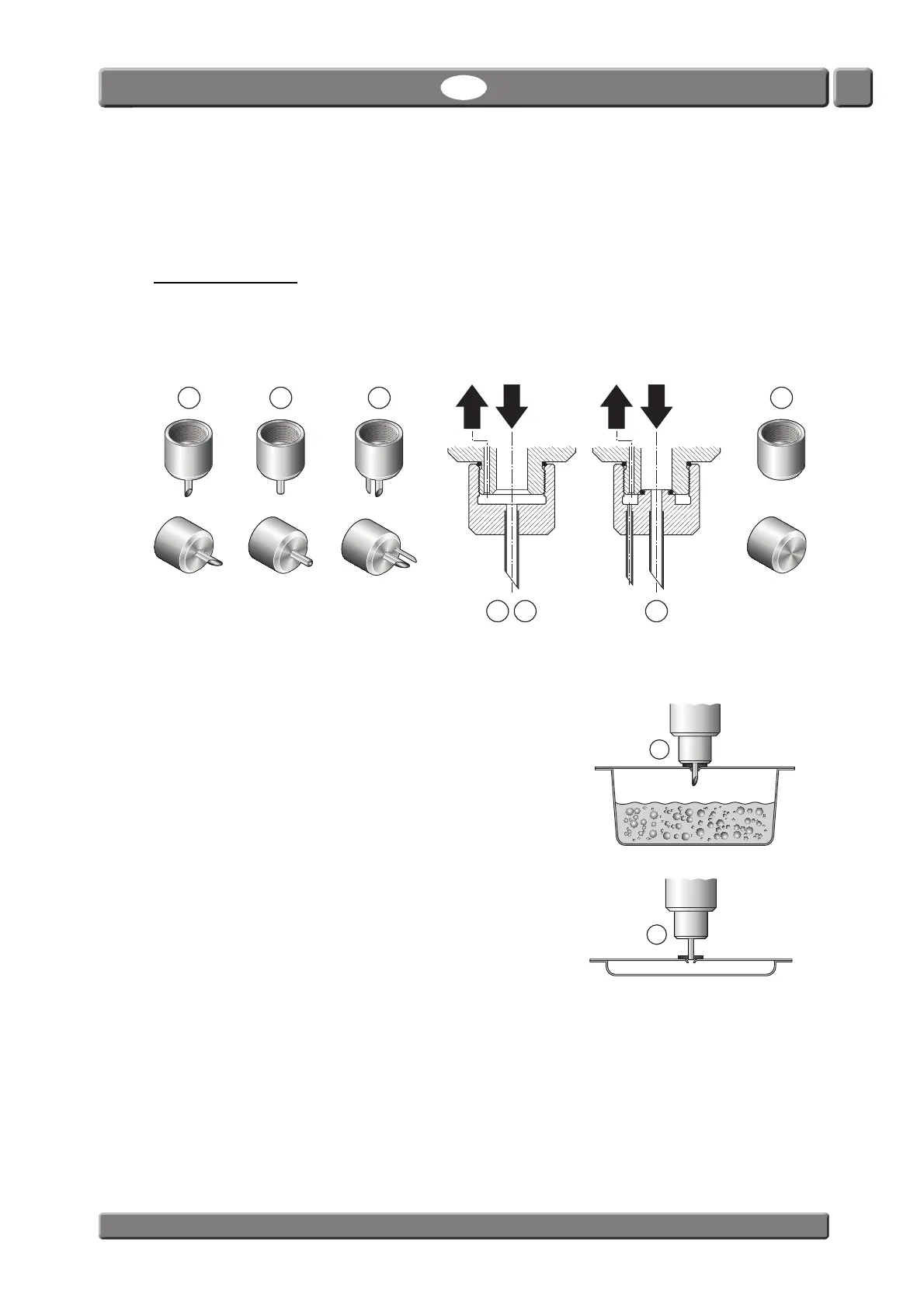
Three different needles are available, the “Sharp” (A) and “Flat” (B) mono needles and the “Twin” (C)
needle.
The mono needles (A) and (B) are suitable for almost all types of packages and should be used together
with septa (see page 34).
The “Sharp” (A) needle can pierce the package by itself and is
primarily used for packages providing enough headspace to
pierce the package without damaging the bottom of the package
or touching any product that might be present in the package.
Press the needle through the hole in the septum and into the
package making sure that the needle is fully seated onto the
septum.
The “Flat” (B) needle is recommended for slim packages in
order to avoid undesired damage to the underside of the
package.
When using the “Flat” (B) needle, first make a small hole with
ex. a knife and place a black septum over the hole. Insert the
needle into the septum but not into the package.
The “Twin” (C) needle is used for burst tests on porous packages. Since the higher flow required for this
type of measurement can influence negatively on the pressure measurement, the “Twin” needle uses a
separate needle for this measurement and an O-ring inside the needle head provides sealing of the two
air channels. You can not use a septum together with the “Twin” needle.
The “Blind” (D) needle head can be used for testing if there are internal leaks in the system.
A
A
B
B
C
C
D
Sense
Sense
Feed
Feed



 To Next Page