This section contains information and knowledge for the operation and care
of the various water system equipment found in the motorhome. The
motorhome is equipped with two separate water systems. Optional water
equipment will also be discussed, so not all information may be applicable to
the motorhome. More detailed information with CAUTION or WARNING
instructions for the various equipment, other than what is found in this section,
can be found in the manufacturer’s manual in the owner information box.
It is hard to imagine how much water is used by the average person every-
day. Newcomers to a self-contained motorhome soon discover water does not
last very long unless consumption is drastically reduced. For example, less
water can be used for showering if the shower is turned off while soaping
down, then turned back on to rinse. This way a good shower uses a gallon or
less of water. There is plenty of water to meet personal needs once you modify
some habits.
Fresh Water System:
The fresh water system consists of fresh water tank, water pump, gravity
fill connection, water filter and a city/fresh water connection.
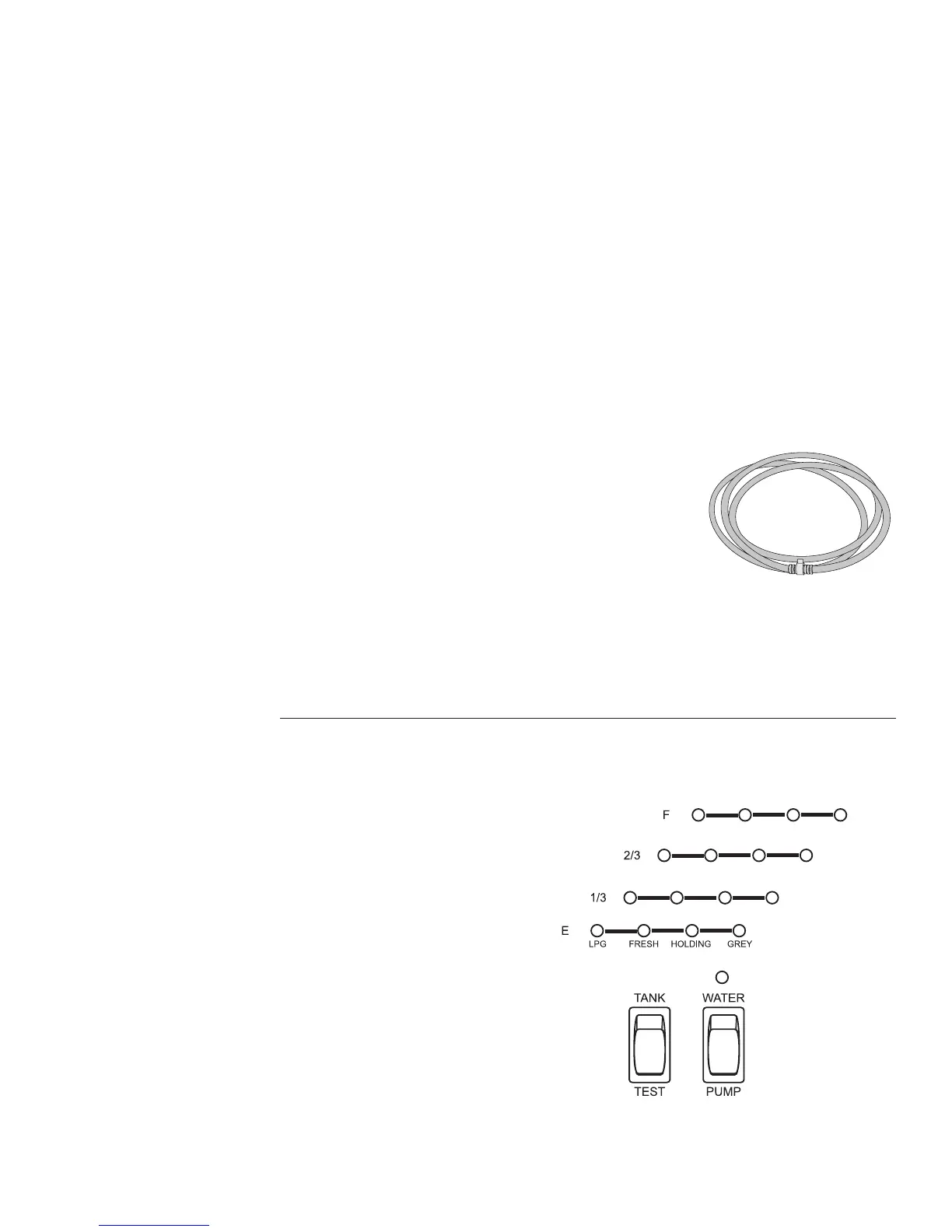
Use the water hose that is marked for potable water use only. Care of the
hose is a must. After each use, drain the water hose and coil the hose neatly.
Attach the ends together to keep debris and insects out of the hose.
Waste Water System:
The waste water system consists of a waste holding tank (grey water), a
sewage holding tank (black water), flush system, toilet and drains.
The motorhome is equipped with a monitor
panel to aide in managing the storage tanks. The
monitor panel will be located in the hall area.
The switch marked test is a momentary switch
which requires being held down while testing
the level of the storage tanks. Read the scale for
the desired storage tank which is to be moni-
tored. Each scale uses colored lights along
with a corresponding scale reading. The lights
and scales indications are as follows:
• Green lamps indicate good or normal ranges.
• Amber lamps indicate fair or partial ranges.
• Red lamps indicate full or empty ranges
(depending on the scale) which are in the
critical range.
Water Systems
------------------------------------------------------------------------------------------------------------------------------------------------------------------------------------------------------------------------------------------------------------------------------------------------------------------
DIPLOMAT
6•169
INTRODUCTION
MONITOR PANEL
Measurement
om040400.EPS
om040436.EPS



 To Next Page