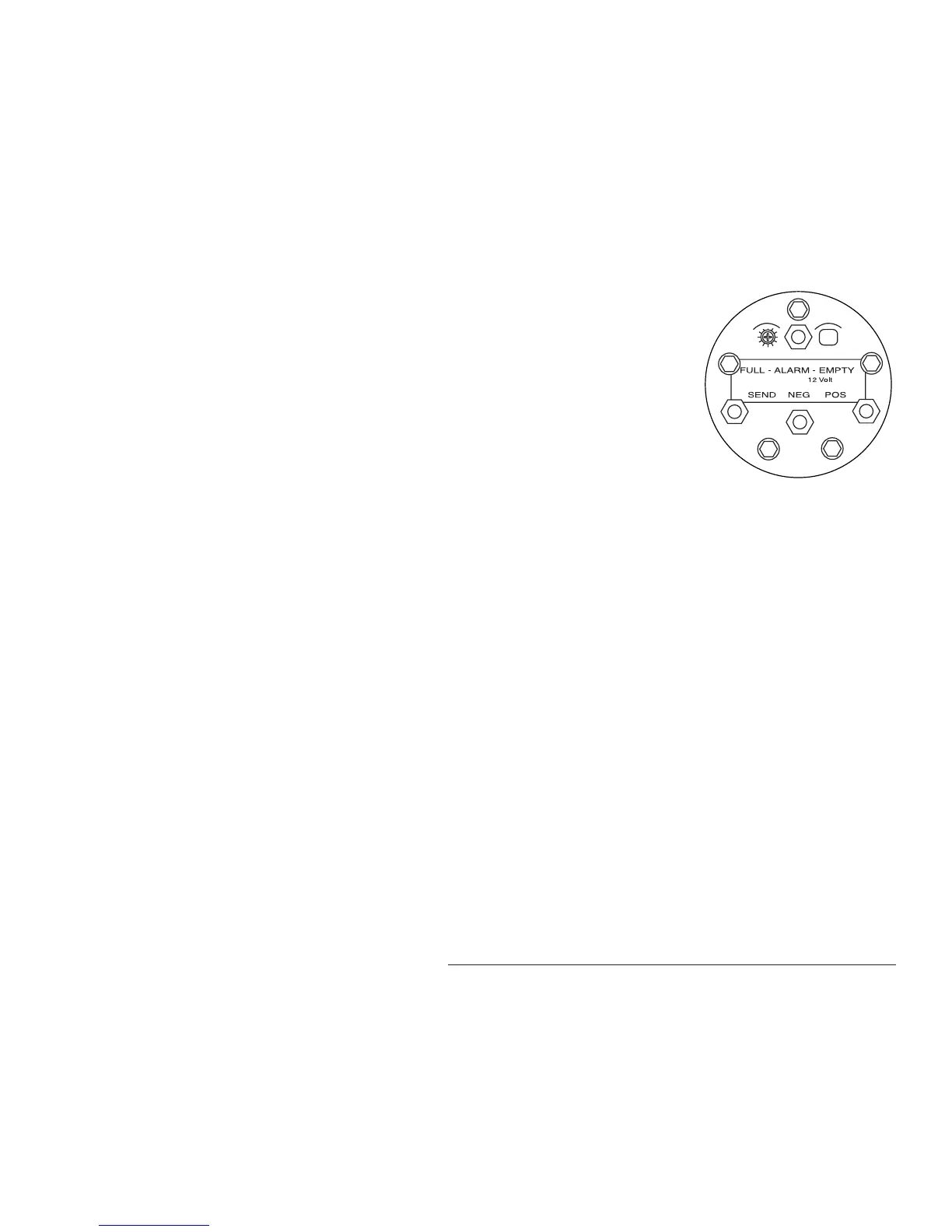
Connections: The Centroid sender has four connections:
• Positive and Negative: Battery voltage to run the electronics in
the sender head.
• Send: Connects to the Send terminal of the gauge on the dash.
• Alarm: Makes a connection internally to the Negative terminal
when the low alarm fuel level is reached (when gauge is reading
about 1/8 tank). This turns on the alarm light on the dash. It is
not adjustable.
Adjustments: The Centroid sender has two adjustments:
• Empty: Adjusts for length of sender. It has been set at the factory and
covered with a sealant. It should not be changed.
• Full Adjustment: The full adjustment can be used to correct for
slight differences between fuel meters. During installation, it has
been calibrated for your meter and should not need readjustment.
The correct adjustment technique, with a full tank of fuel, is to start
with the full adjustment screw completely clockwise. This should cause the
reading to be above full. Then adjust slowly counterclockwise until the full
mark is reached.The intent is to always adjust downscale rather than upscale.
Troubleshooting:
A. Electronic output: The sender has a transistorized output. This prevents
an ohmmeter from getting a correct reading of its output resistance.
B. Fuel Only: The sender will not work correctly in conducting fluids
such as water (it will read above full all the time in water). One
possibility is that when there is a constant above-full reading there
may be water in the bottom of the fuel tank.
C. Contact Centroid: Probably 90% of the return Centroid tests work
okay on the bench. If you have incorrect readings contact Centroid
(telephone: 800-423-3574 or, preferably, fax: 904-423-3709) with the
symptoms. A short,“fill in the blanks” troubleshooting test is provided,
appropriate to the sender. It is easier to find the problem that way
than after the sender has been removed from the system, since the
problem is not necessarily with the sender.
Make a visual check for fuel leaks at all engine-mounted fuel lines and
connections and at the fuel tank suction and return lines. Leaks in this area
may best be detected by checking for accumulation of fuel under the tank.
Engine performance and auxiliary equipment is dependent upon the ability of
flexible hoses to transfer lubricating oil, air, coolant and fuel oil. Diligent
maintenance of hoses is an important step in ensuring efficient, economical
and safe operation of engine and related equipment.
Chassis Information
------------------------------------------------------------------------------------------------------------------------------------------------------------------------------------------------------------------------------------------------------------------------------------------------------------------
DIPLOMAT 10•299
Fuel Sending Unit.
Fuel Lines & Hoses
om090318.eps




 To Next Page