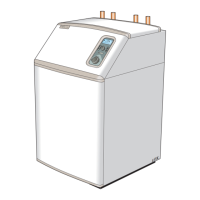
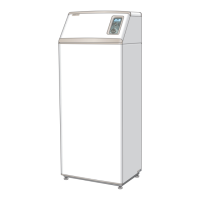
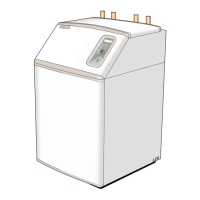
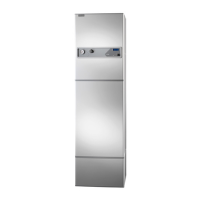
NIBE FIGHTER 1250
The indoor temperature depends on several factors.
Sunlight and heat emissions from people and house-
hold machines are normally suffi cient to keep the house
warm during the warmer parts of the year.
When it gets colder outside, the heating system must
be started. The colder it is outside, the warmer radia-
tors and under fl oor heating systems must be.
Controlling heat production
Normally the heat pump heats the water (heating medium)
to the temperature required at a certain outdoor tempera-
ture. This occurs automatically on the basis of the collected
temperature values from the outdoor sensor and sensors
on the lines to the radiators (fl ow line sensors).
However, the correct default settings must be made on the
heat pump fi rst, see the section “Default settings”.
The temperature information that the outdoor sensor
(mounted on an exterior wall of the house) sends to the
heat pump’s control computer senses variations in the
outdoor temperature early on. It does not have to be cold
inside the house before the control system is activated, as
soon as the temperature drops outside, the temperature of
the water to the radiators inside the house automatically
increases.
Radiator temperature
The temperature of the radiators in relation to the outdoor
temperature can be determined by you by selecting a heat
curve and by using the ”Offset heat curve” knob on the
heat pump’s front panel.
Default setting
The basic heating is set using menu 2.1 and with the
“Heating curve offset” knob.
If you do not know the correct settings use the basic data
from the map opposite.
Changing the room temperature manually
If you want to temporarily or permanently increase or low-
er the indoor temperature turn the ”Offset heating curve”
knob clockwise or anticlockwise. One line approximately
represents a 1 degree change in room temperature.
A
Heating settings
Heating settings
An increase in the room temperature may
be inhibited by the radiator or underfloor
heating thermostats, if so these must be
turned up.
Wait one day between settings so that the
temperatures have time to stabilise.
Note!
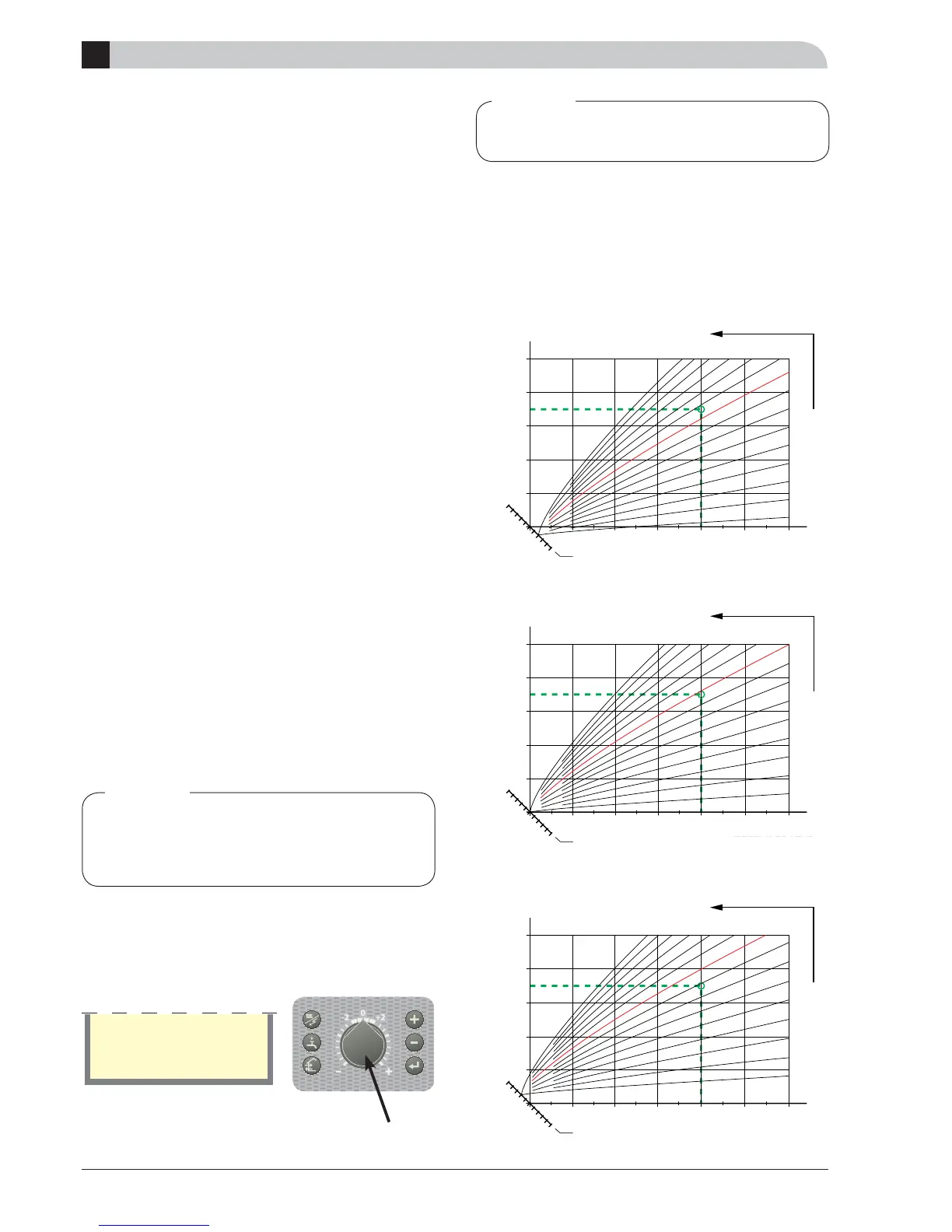
Shifting the heating curve -2
Shifting the heating curve 0
Shifting the heating curve +2
Setting with diagrams
The diagram is based on the dimensioned outdoor temper-
ature in the area and the dimensioned supply temperature
of the heating system. When these two values “meet”, the
heating control's curve coeffi cient can be read. This is set
under menu 2.1, Curve coeffi cient.
Menu 2.1 Curve coeffi cient Offset heating curve
HEATING CURVE
OFFSET HEAT CURVE
SUPPLY TEMPERATURE
OUTSIDE TEMPERATURE
HEATING CURVE
OFFSET HEAT CURVE
SUPPLY TEMPERATURE
OUTSIDE TEMPERATURE
HEATING CURVE
OFFSET HEAT CURVE
SUPPLY TEMPERATURE
OUTSIDE TEMPERATURE
Note!
9
C u r v e c o e f f i c i e n t
2 . 1



 To Next Page