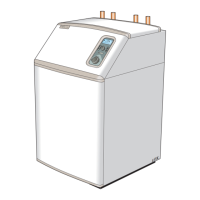
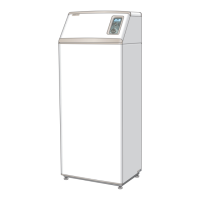
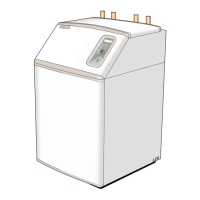
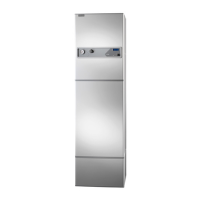
NIBE FIGHTER 1250
Your heat pump is, in principle, maintenance free and
therefore requires minimal care after commissioning.
The heat pump, however, consists of many parts and there-
fore has integrated monitoring functions to assist you.
If something abnormal occurs, a message appears
about malfunctions in the form of different ”alarm”
texts in display.
The brine that obtains the heat in the ground is not
normally consumed but just pumped around. There is
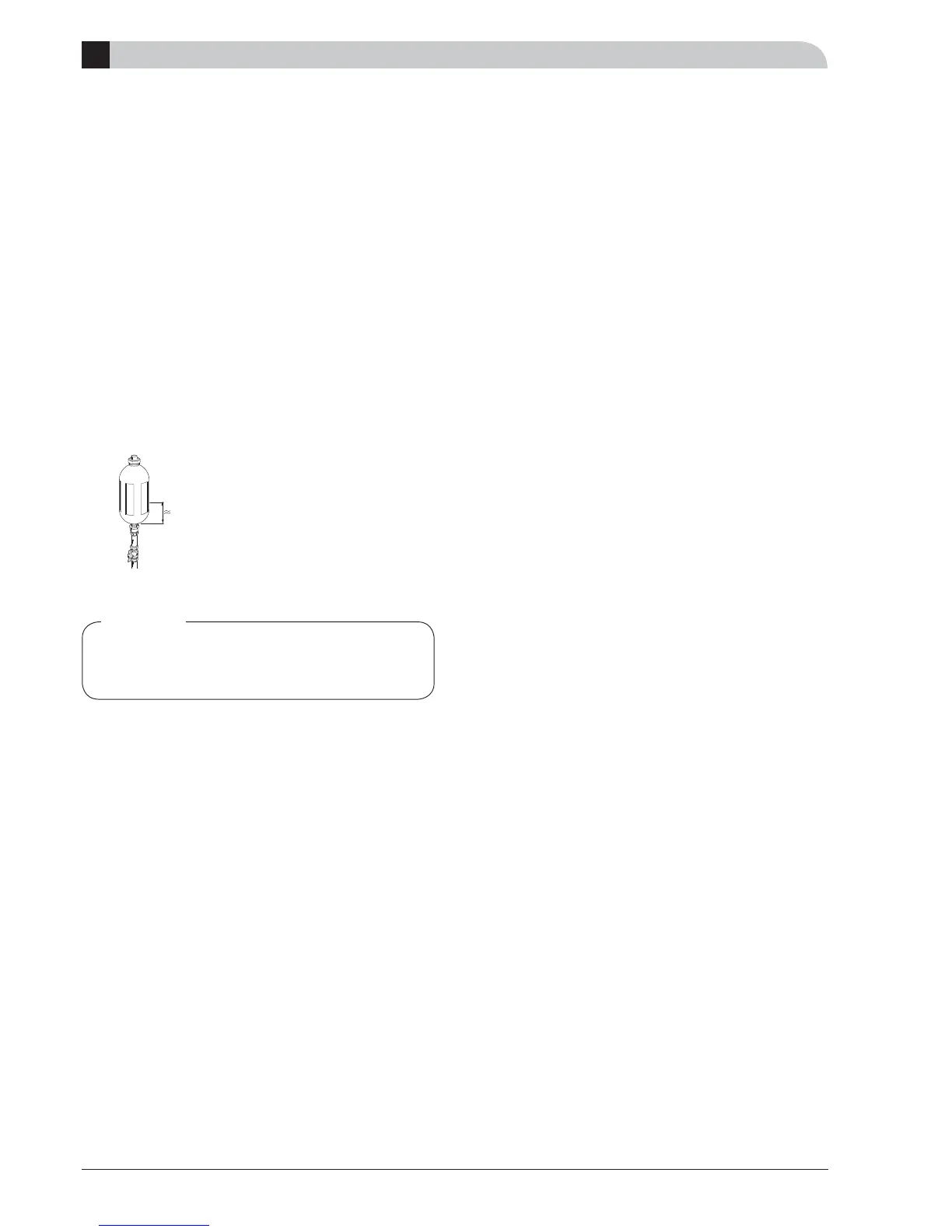
a level vessel where you can check if there is suffi cient
fl uid in the system. The level can vary due to the fl uid’s
temperature. If the level is about 1/3, top up.
(See section ”Readjustment, collector side”)
Check for leakage.
Saving tips
Your heat pump installation produces heat and hot water
according to your needs. It also attempts to carry out all
requirements with all available ”aids” from the control set-
tings made.
Known factors that affect the energy consumption are, for
example, the indoor temperature, hot water consumption
and the insulation level of the house, as well as the level of
comfort you require.
Also remember:
Open the thermostat valves fully
(with the exception of those rooms that may be re-
quired to be cooler, e.g. bedrooms).
Thermostat valves in the radiators and fl oor loops can
negatively affect the energy consumption. They slow the
fl ow in the heating system, which the heat pump wants
to compensate with increased temperatures. It then works
harder and consumes more electrical energy.
A
Maintenance
Maintenance
Never carry out any work on a heat pump
that requires special permission e.g. on elec-
trical or cooling parts.
Safety valves
The heating system’s and hot water heater’s safety
valves can, at temperature changes, release a little wa-
ter.
The overfl ow water pipes from the safety valves must
not be obstructed and must be visible.
The safety valves must be checked regularly to prevent
blockages. This is usually done by turning the safety
valve’s knob anti-clockwise. The water should then
fl ow through the safety valve. If this does not happen,
replace the safety valve.
The appearance and location of the safety valves differs
between different installations. Contact your installer for
information.
Emptying the hot water heater
The siphon principle is used to empty the hot water heater.
This can be done either via the drain valve on the incoming
cold water pipe or by inserting a hose into the cold water
connection.
Note!



 To Next Page