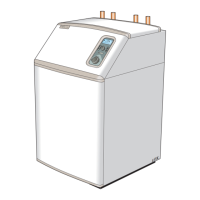
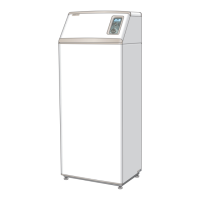
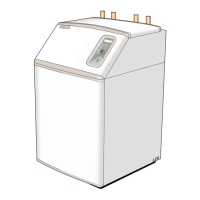
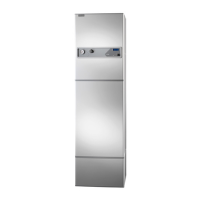
NIBE FIGHTER 1250
The heat pump’s sub system and its function
Some heat pump technology
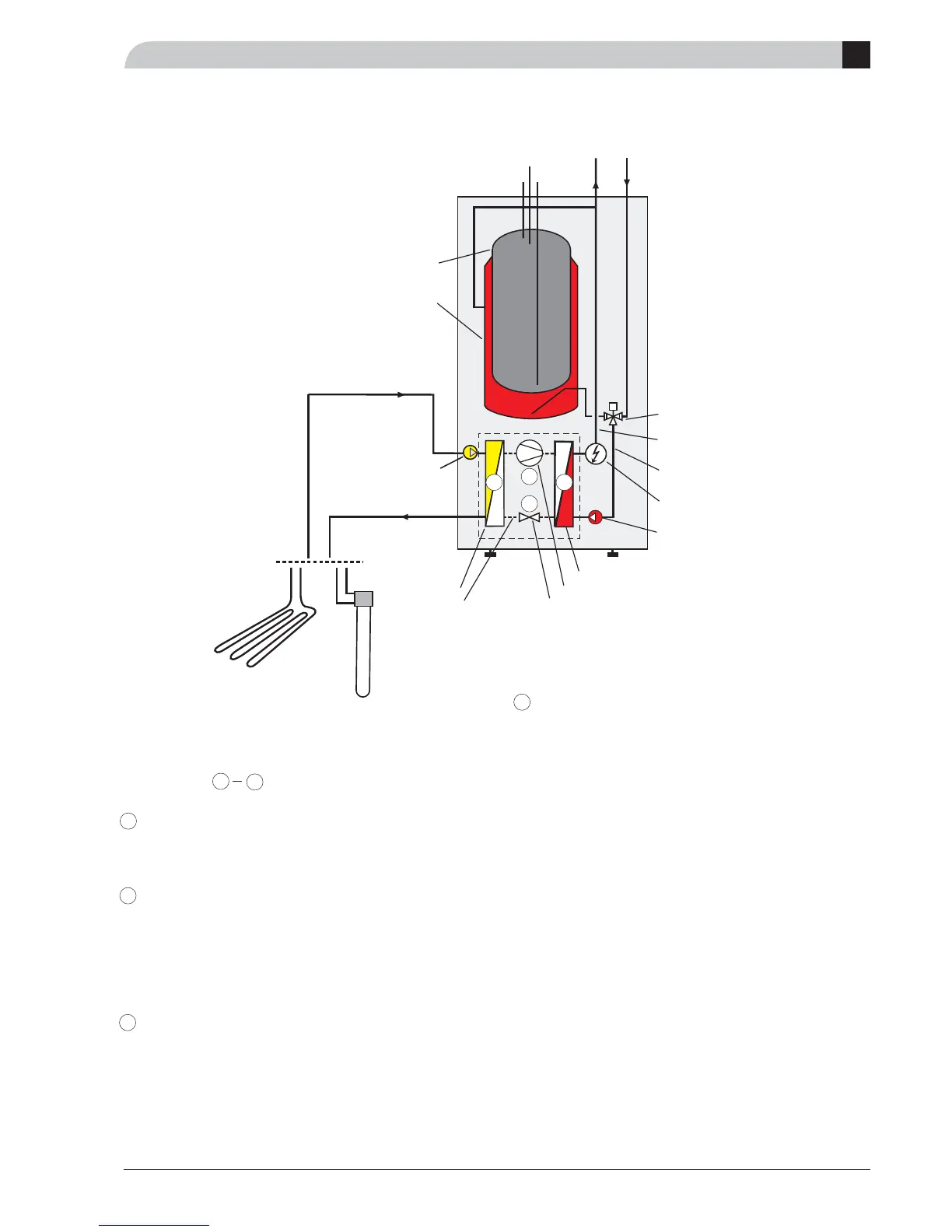
The heat pump functions can easily be divided into four
sub processes:
1. Fluid ( the refrigerant) that is used in our heat pump
boils* at a very low temperature in the evaporator. The
heat retrieved by the circulating fl uid (the brine) from
the ground/rock/lake is enough to cause it to boil.
2. The steam (gas) that is produced when the refrigerant
boils, is drawn into the speed controlled compressor.
There it is compressed just enough for the relevant heat
demand. As the pressure of the gas increases it also be-
comes extremely hot.
(The low temperature refrigerant has been converted to
a high tempered gas)
3. The hot gas is routed into a heat exchanger ( condenser)
where it releases its heat into the heating system’s water
( heating medium). It passes through the same con-
denser but on the other side of a separating wall so that
the mediums do not mix.
When heat is transferred to the heating medium the gas
is cooled and converted to a fl uid again (condenses).
A
The heat pump’s sub system and its function
4. The expansion valve fi nally reduces the pressure of
the fl uid (refrigerant, so that it can be re-boiled at a low
temperature) at the same time as it only releases the
exact amount of fl uid to the evaporator that is to be
reheated and evaporated by the heat retrieved from the
ground.
The described process is repeated over and over and
only the compressor and circulation pumps require elec-
trical energy during normal operation.
The energy for the heating system - and domestic
hot water is obtained, as described above, from the
ground. The heat pump’s COP value determines how
effectively this is carried out( heating factor). The value is
a measurement of how much heat is obtained in rela-
tion to consumed electrical energy.
*) The boiling point of different fl uids varies but the pres-
sure in the vessel is important. Water boils at +100 °C in
a saucepan on a hob but would have done so at +80 °C
if the air pressure in the room had been half as high. This
is a property that is used within heat pump technology.
Note that all material that has a greater temperature
than -273 °C contains heat that is possible to recover, the
greater the temperature of the refrigerant the more ef-
fectively this can be carried out.
1
2
3
1
4
Värmebärarpump
(varvtalsstyrd)
Eltillsats
Växelventil
Värmebärare fram
(VBF)
Värmebärare retur
(VBR)
Förångare
Köldbärarpump
(varvtalsstyrd)
Kompressor (varvtalsstyrd)
Kondensor
VV KV
Expansionsventil
Köldmediei
Värme
returledning
Dubbelmantel
Köldbärare in (KBin)
Köldbärare ut (KBut)
Varmvattenberedare
Värme
framledning
2
1 3
4
HWC
HW CW
Heating flow
line
Heating return
line
Hot water heater
Double jacket
Brine in (KBin)
Brine pump (speed
controlled)
Brine out (KBut)
Evaporator
Refrigerant
Expansion valve
Compressor (speed controlled)
Condenser
Heating medium
pump (speed control-
led)
Electrical addition
Heating medium
return (VBR)
Heating medium flow
(VBF)
Shuttle valve
4



 To Next Page