539
Double-precision Floating-point Instructions Section 3-15
If the absolute value of the result is greater than the maximum value that can
be expressed as floating-point data, the Overflow Flag will turn ON and the
result will be output as
±∞.
If the absolute value of the result is less than the minimum value that can be
expressed as floating-point data, the Underflow Flag will turn ON and the
result will be output as 0.
The various combinations of minuend and subtrahend data will produce the
results shown in the following table.
Note (1) The results could be zero (including underflows), a numeral, +
∞, or –∞.
(2) The Error Flag will be turned ON and the instruction will not be executed.
Flags
Precautions The Minuend (Mi to Mi+3) and Subtrahend (Su to Su+3) data must be in
IEEE754 floating-point data format.
Minuend
Subtrahend 0 Numeral +∞ –∞ NaN
0 0 Numeral +∞ –∞
Numeral Numeral See note 1. +∞ –∞
+∞ –∞ –∞ See note 2. –∞
–∞ +∞ +∞ +∞ See note 2.
NaN See note 2.
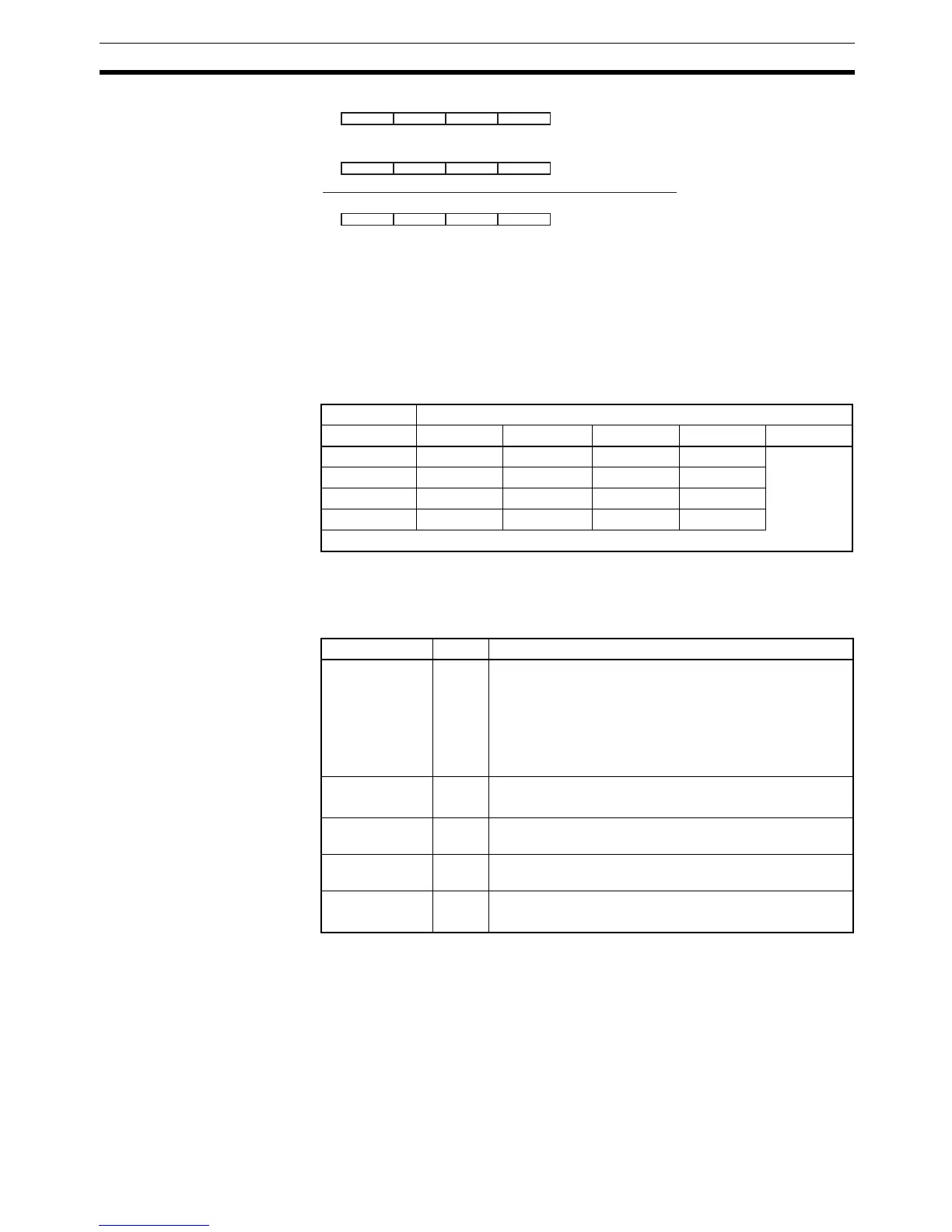
S1+1
S2+1
−
S1
S2
D+1 D
S1+2
S2+2
D+2
S1+3
S2+3
D+3
Minuend (floating-point data, 64-bits)
Subtrahend (floating-point data, 64-bits)
Result (floatin
-point data, 64-bits)
Name Label Operation
Error Flag ER ON if the minuend or subtrahend data is not recognized
as floating-point data.
ON if the minuend or subtrahend is not a number (NaN).
ON if +∞ is subtracted from +∞.
ON if –∞ is subtracted from –∞.
OFF in all other cases.
Equals Flag = ON if both the exponent and mantissa of the result are 0.
OFF in all other cases.
Overflow Flag OF ON if the absolute value of the result is too large to be
expressed as a double-precision floating-point value.
Underflow Flag UF ON if the absolute value of the result is too small to be
expressed as a double-precision floating-point value.
Negative Flag N ON if the result is negative.
OFF in all other cases.


 To Next Page