68
Interrupt Tasks Section 2-3
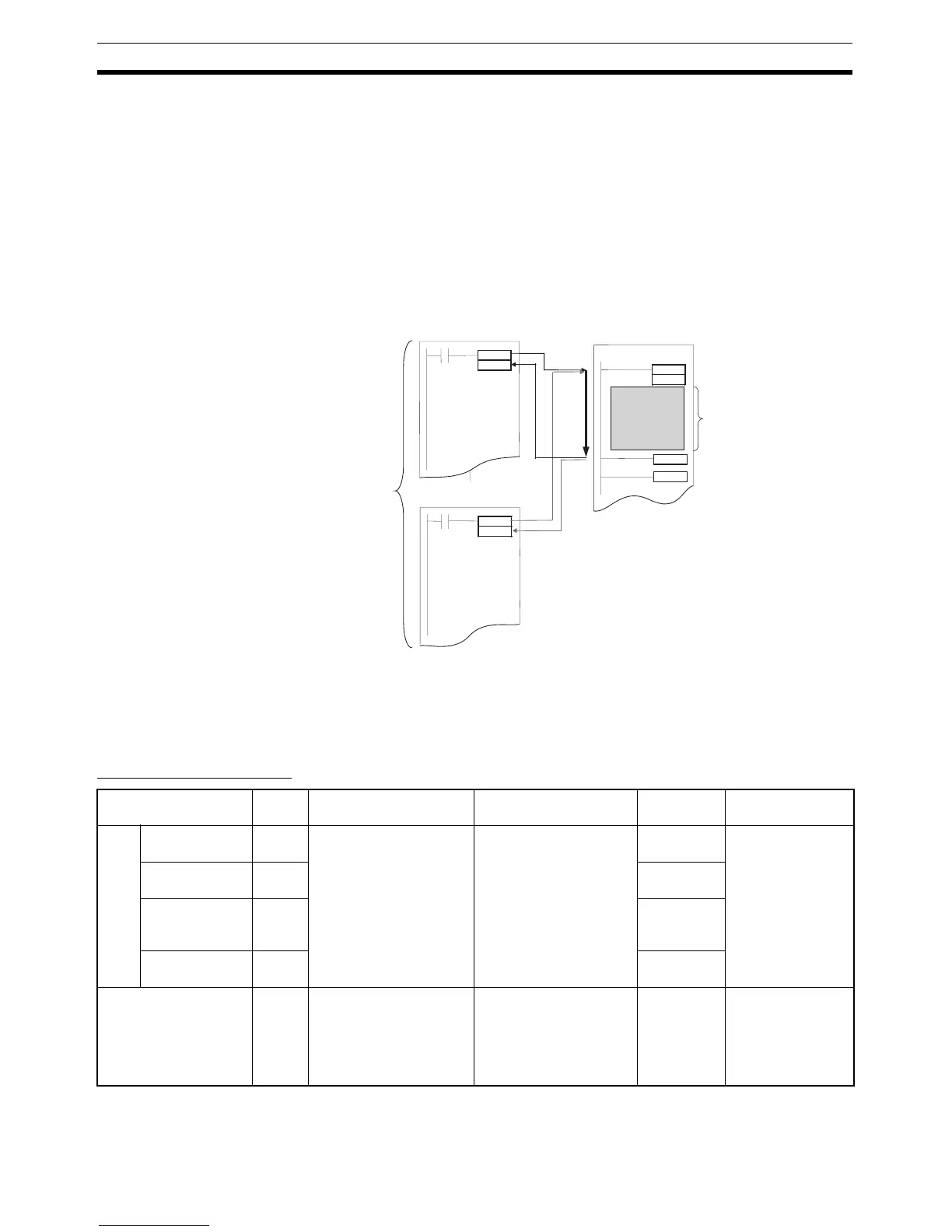
2-2-6 Global Subroutine
A subroutine in one task cannot be called from other tasks. A subroutine
called a global subroutine can be created in interrupt task number 0, and this
subroutine can be called from cyclic tasks (including extra cyclic tasks).
GSBS(750) is used to call a global subroutine. The subroutine number must
be between 0 and 255. The global subroutine is defined at the end of interrupt
task number 0 (just before END(001)) between GSBN(751) and GRET(752)
instructions.
Global subroutines can be used to create a library of standard program sec-
tions that can be called whenever necessary.
2-3 Interrupt Tasks
2-3-1 Types of Interrupt Tasks
List of Interrupt Tasks
GSBN
n
GSBS
n
GSBS
n
GRET
END
Cyclic task (including
extra cyclic task)
Multiple tasks
Cyclic task (including
extra cyclic task)
Call
Call
Exe-
cution
Return
Return
Interrupt task 0
n = 0 to 1,023
Global subroutine
(shared subroutine
used for standard
programming)
Type Task
No.
Execution condition Setting procedure Number of
interrupts
Application
examples
Input
Inter-
rupts
CP1H
X/XA: 0 to 7
140 to
147
An interrupt occurs when
an interrupt input built
into the CPU Unit turns
ON or OFF in Direct
Mode or when a speci-
fied number of ON or
OFF signals is detected
at the interrupt input in
Counter Mode.
Use the SET INTER-
RUPT MASK instruction
MSKS(690) to specify
which interrupt inputs
are enabled.
8 points Increasing
response speed to
specific inputs
CP1H
Y: 0 to 5
140 to
145
6 points
CP1L
M, or L (20 I/O):
0 to 5
140 to
145
6 points
CP1L
L (14 I/O): 0 to 3
140 to
143
4 points
High-speed counter
interrupts
0 to
255
An interrupt occurs when
a condition is met for a
target value or range
comparison for the
present value of a high-
speed counter.
Use the COMPARISON
TABLE LOADinstruction
(CTBL(882)) to specify
the execution condition
and the interrupt to exe-
cute.
256 points Performing posi-
tioning operations
based on counting
encoder pulses


 To Next Page