42
Checking Programs Section 1-3
1-3-2 Program Checks with the CX-Programmer
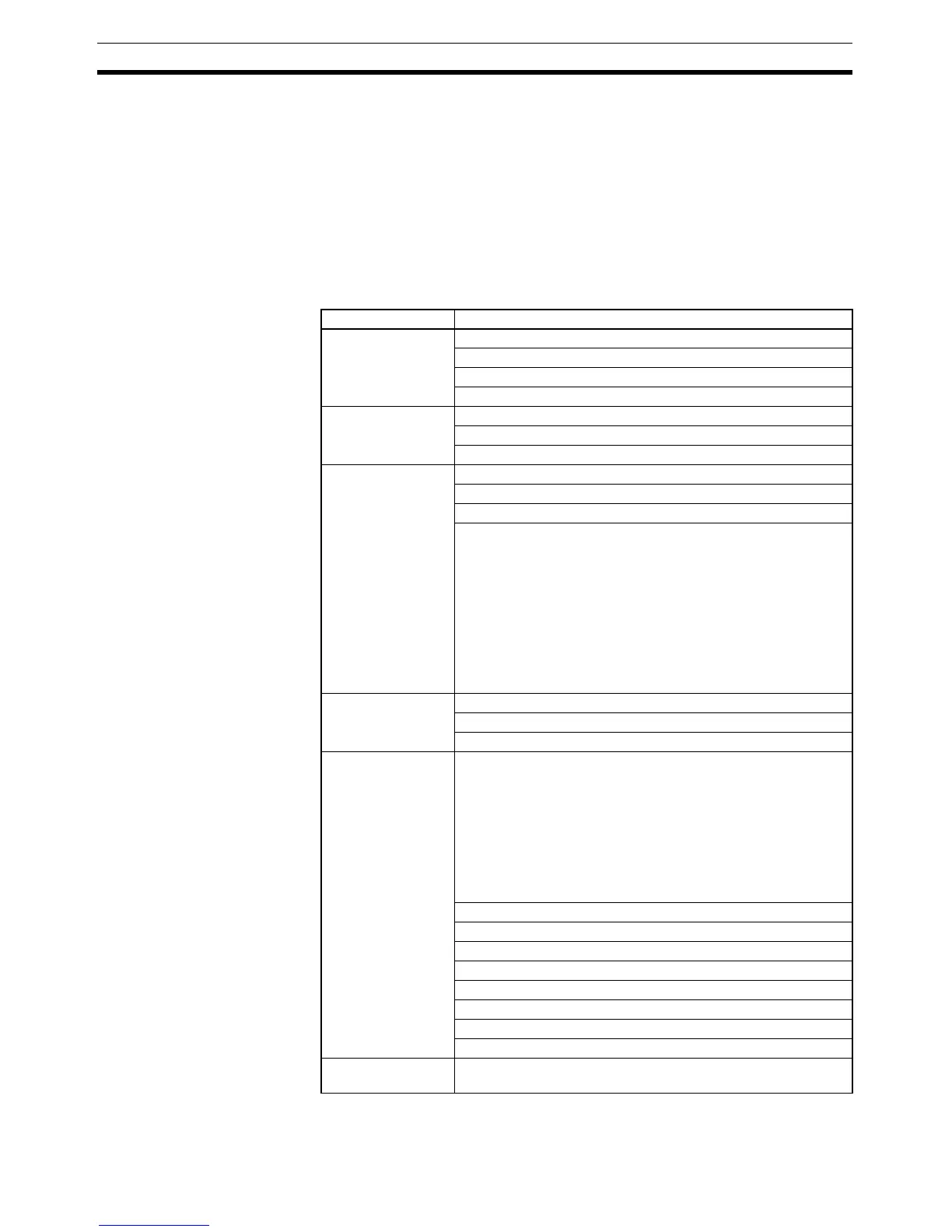
The errors that are detected by the program check provided by the CX-Pro-
grammer are listed in the following table.
The CX-Programmer does not check range errors for indirectly addressed
operands in instructions. Indirect addressing errors will be detected in the pro-
gram execution check and the ER Flag will turn ON, as described in the next
section. Refer to individual instruction descriptions for details.
When the program is checked on the CX-Programmer, the operator can spec-
ify program check levels A, B, and C (in order of the seriousness of the error),
as well as a custom check level.
Area Check
Illegal data: Ladder
diagramming
Instruction locations
I/O lines
Connections
Instruction and operation completeness
Instruction support
by PLC
Instructions and operands supported by PLC
Instruction variations (NOT, !, @, and %)
Object code integrity
Operand ranges Operand area ranges
Operand data types
Access check for read-only words
Operand range checks, including the following.
• Constants (#, &, +, –)
• Control codes
• Area boundary checks for multi-word operands
• Size relationship checks for multi-word operands
• Operand range overlaps
• Multi-word allocations
• Double-length operands
• Area boundary checks for offsets
Program capacity
for PLC
Number of steps
Overall capacity
Number of tasks
Syntax Call check for paired instructions
•IL–ILC
• JMP–JME, CJP/CJPN–JME
• SBS–SBN–RET, MCRO–SBN–RET
• STEP–SNXT
• BPRG–BEND
•IF–IEND
• LOOP–LEND
Restricted programming locations for BPRG–BEND
Restricted programming locations for SBN–RET
Restricted programming locations for STEP–SNXT
Restricted programming locations for FOR–NEXT
Restricted programming locations for interrupt tasks
Illegal nesting
END(001) instruction
Number consistency
Ladder diagram
structure
Stack overflows


 To Next Page