640
Data Control Instructions Section 3-17
Description When the execution condition is ON, BAND(681) controls output data accord-
ing to whether or not the specified input data (signed 16-bit binary) is within
the upper and lower limits (dead band). The contents of words C and C+1 are
as follows:
C and C+1 must have the same area classification.
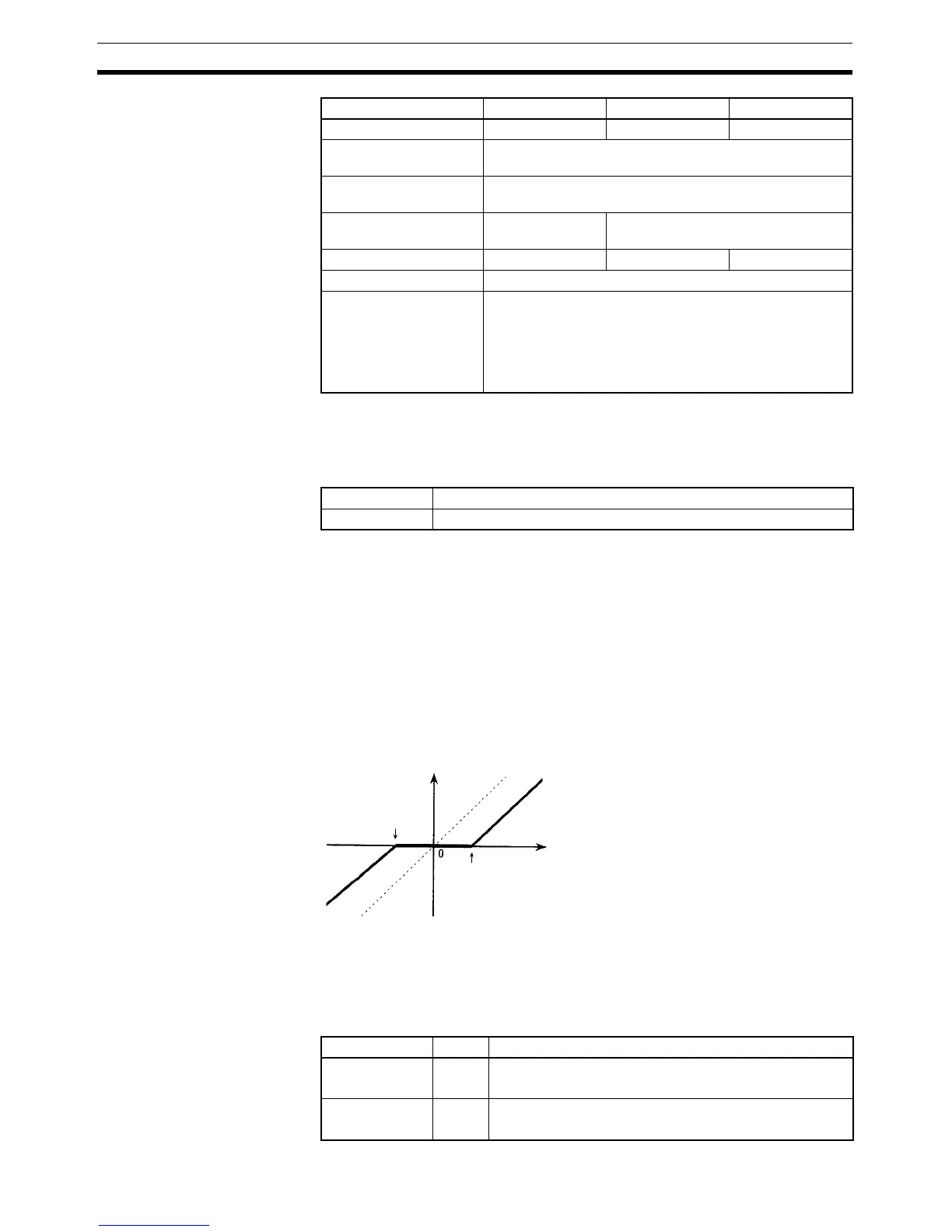
If the input data (S) is greater than or equal to the lower limit (C) and less than
or equal to the upper limit (C+1), 0000 (hex) will be output to D and the Equals
Flag will turn ON.
If the input data (S) is less than the lower limit (C), the difference between the
input data minus the lower limit data will be output to D and the Less Than
Flag will turn ON.
If the input data (S) is greater than the upper limit (C+1), the difference
between the input data minus the upper limit data will be output to D and the
Greater Than Flag will turn ON.
If the output data is smaller than the 8000 (hex) or if is greater than 7FFF, the
sign will be reversed. For example, for a lower limit of 0100 (hex) and input
data of 8000 (hex), the output data will be as follows:
8000 (hex) [–32768] – 0100 (hex) [256] = 7F00 (hex) [32512]
Flags
DM Area D0 to D32767 D0 to D32766 D0 to D32767
Indirect DM addresses
in binary
@ D0 to @ D32767
Indirect DM addresses
in BCD
*D0 to *D32767
Constants #0000 to #FFFF
(binary)
---
Data Registers DR0 to DR15 --- DR0 to DR15
Index Registers ---
Indirect addressing
using Index Registers
,IR0 to ,IR15
–2048 to +2047 ,IR0 to –2048 to +2047 ,IR15
DR0 to DR15, IR0 to IR15
,IR0+(++) to ,IR15+(++)
,–(– –)IR0 to, –(– –)IR15
Area S C D
C Lower limit data (dead band lower limit)
C+1 Upper limit data (dead band upper limit)
Upper limit (C+1)
Output
Input
Lower limit (C)
Name Label Operation
Error Flag ER ON if the upper limit is less than the lower limit.
OFF in all other cases.
Greater Than
Flag
> ON if the input data (S) is greater than the upper limit.
OFF in all other cases.


 To Next Page