715
High-speed Counter/Pulse Output Instructions Section 3-20
Example 2
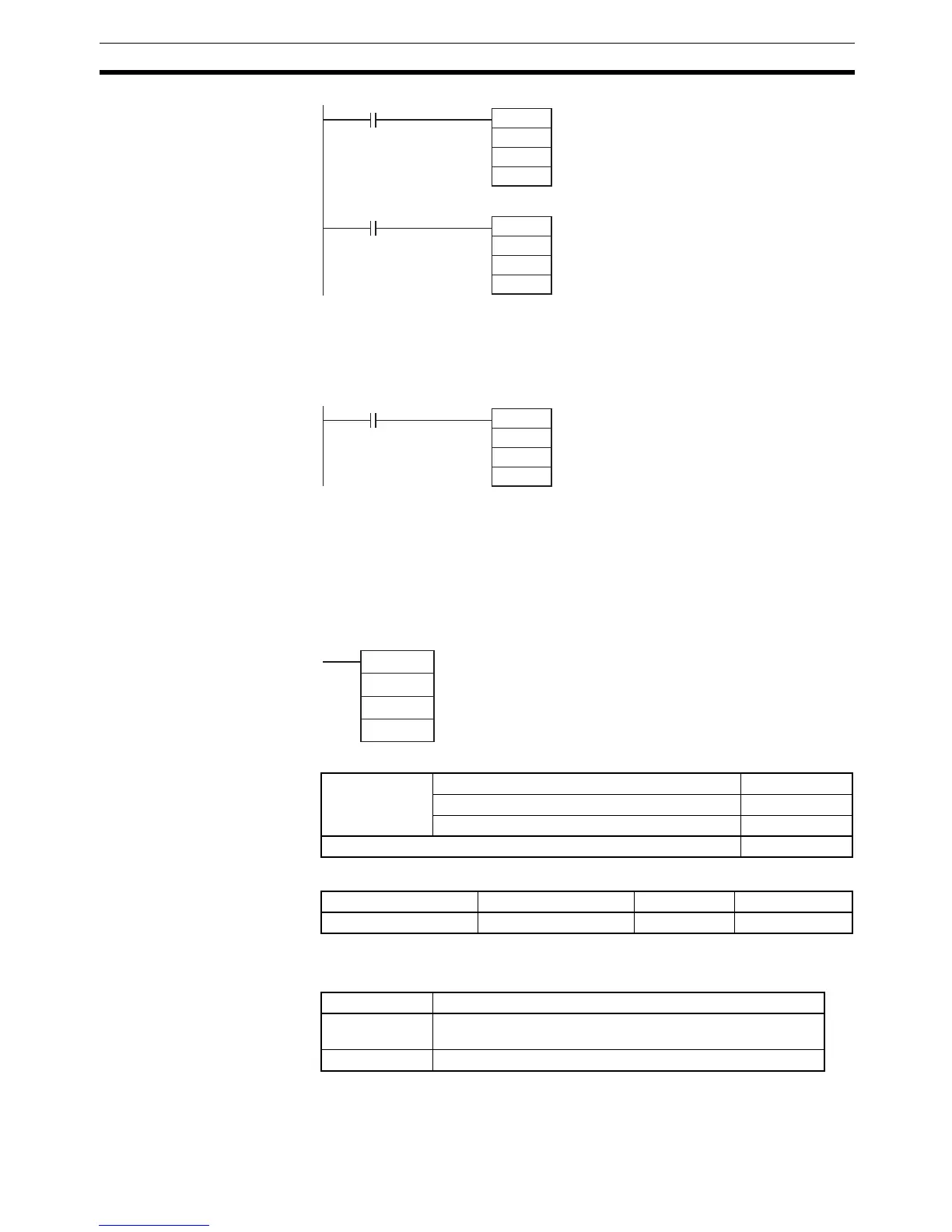
When CIO 0.01 turns ON in the following programming example, PRV(881)
reads the frequency of the pulse being input to high-speed counter 0 at that
time and stores it as a hexadecimal value in D201 and D200.
3-20-3 COUNTER FREQUENCY CONVERT: PRV2(883)
Purpose PRV2(883) reads the pulse frequency input from a high-speed counter and
either converts the frequency to a rotational speed or converts the counter PV
to the total number of revolutions. The result is output to the destination words
as 8-digit hexadecimal. Pulses can be input from high-speed counter 0 only.
Ladder Symbol
Variations
Applicable Program Areas
Operands C1: Control Data
The function of PRV2(883) is determined by the control data, C1.
Note The second digit of C (@) specifies the units and the third digit (*) specifies
the frequency calculation method.
@CTBL
#0000
#0001
D100
0.00
@PRV
#0010
#0002
100
0.01
Range comparison table
registration and comparison star
High-speed counter input 0
Read range comparison results
High-speed counter input 0
PRV
#0010
#0003
D200
0.01
High-speed counter input
Read input frequency
PRV2
C1
C2
D
C1: Control data
C2: Pulses per revolution
D: First destination word
Variations Executed Each Cycle for ON Condition PRV2(883)
Executed Once for Upward Differentiation @PRV2(883)
Executed Once for Downward Differentiation Not supported
Immediate Refreshing Specification Not supported
Block program areas Step program areas Subroutines Interrupt tasks
OK OK OK OK
C1 PRV2(883) function
0@*0 hex
(See note.)
Converts frequency to rotation speed.
0001 hex Converts counter PV to total number of revolutions.


 To Next Page