7-12 Safety Features and Equipment
PA-1628Operator's ManualH3-45 COACH
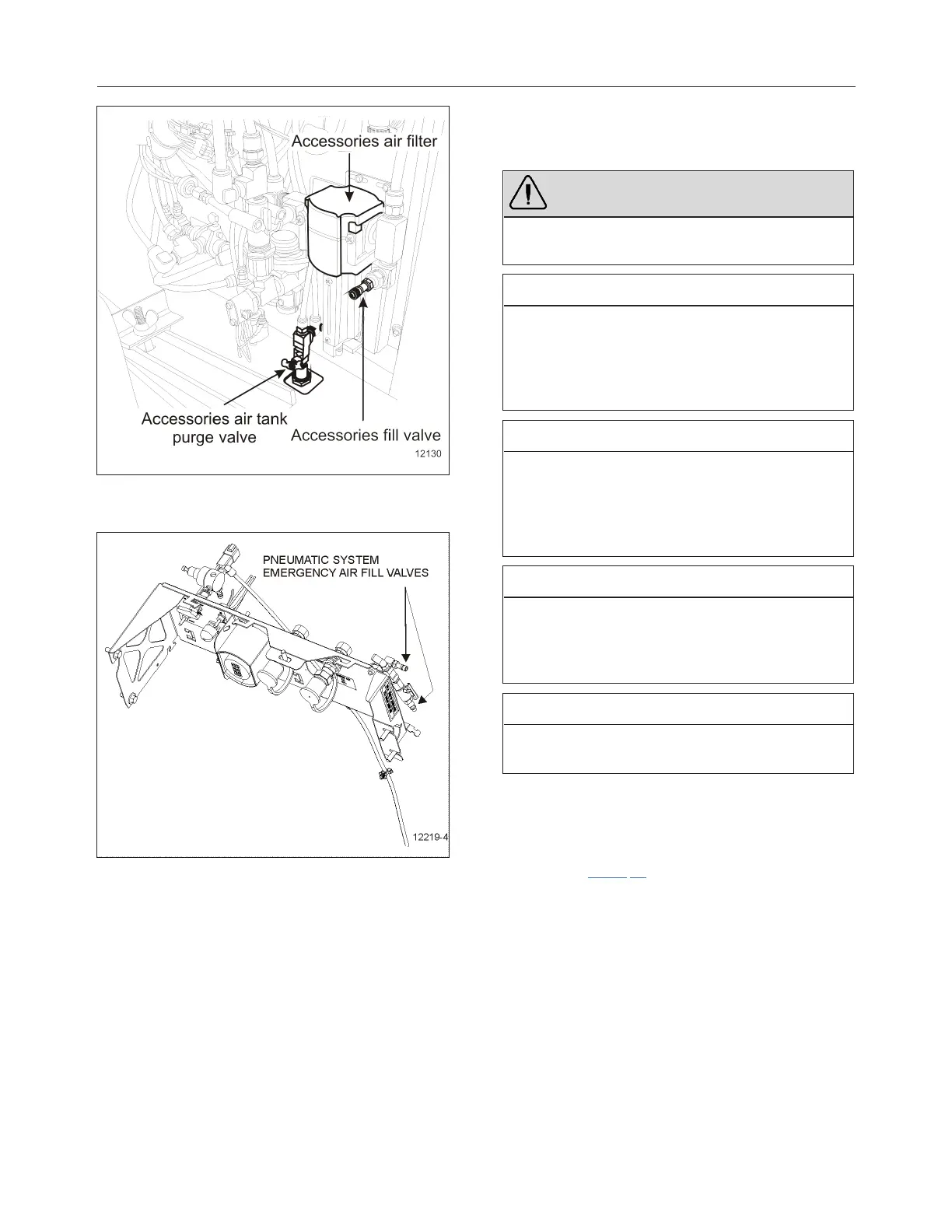
FRONT SERVICE COMPARTMENT
FILL FITTING IN ENGINE COMPARTMENT
EMERGENCY AND PARKING BRAKES
During normal operation, if air pressure in any brake
circuit drops below 60 psi (414 kPa), spring-loaded
emergency brake will be immediately applied at full
capacity to the drive axle wheels to stop the vehicle.
Spring-loaded parking brake is applied by pulling up
the control valve knob located on the L.H. lateral
console.
Parking brake is not designed to be used as a
service brake. For normal driving conditions, the
control valve knob must remain depressed.
WARNING
Always apply the parking brake before leaving the
driver's seat.
NOTE
Only use the parking brake to supplement the
service brake to stop the vehicle in emergency
conditions. The stopping distance will be
considerably longer than when using normal
service brake.
NOTE
Before releasing the parking brake by pushing
down the control valve knob, check the pressure
gages to make sure that the brake system air
pressure is greater than or equal to 95 psi (655
kPa).
NOTE
The alarm will sound if the ignition switch has been
turned to OFF without applying the parking brake.
The same beep will sound if pressure is still
applied to the service brake pedal.
NOTE
The stop lights automatically turn on when the
parking brake is applied and the engine is running.
VEHICLE JACKING POINTS
For detailed instructions, refer to Maintenance
information MI18- 18 , available on the technical
publications USB key and website.
HYDRAULIC JACK
To raise: turn release valve clockwise. Insert handle
in socket and raise vehicle by pumping.
To lower: remove handle and turn the release valve
slowly counterclockwise.
Always keep ram and extension screw retracted
when jack is not in use.








 To Next Page