6
NOTES
Notes on installation
WARNING
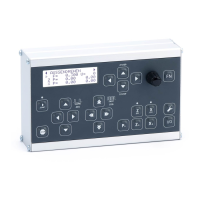
The ELS controls are simple cycle controls that allow fully automatic cycle machining with
a conventional lathe. For this purpose, drives must be mounted on the axes of the ma-
chine and a rotary encoder for position feedback must be mounted on the main spindle.
Equipped with these components, the machine can then be controlled in 2 axes. The ELS control
generates control signals for the drive motors from the encoder signals. These are strictly coupled to
the movement of the main spindle by the rotary encoder, thus creating an electronically controllable
gear. This means that many operations can be carried out automatically and speed-dependently.
In addition, the user can freely select the feed rate on the ELS where gear changes or change
gears previously had to be made.
Possible application
The ELS control system allows various applications to be carried out automatically that were
only possible manually before installation. With the ELS, the user can cut threads in all pitches,
even tapered- or multi-threads. It is possible to turn radii and cones, inside and outside, radii
in concave or convex with cutting radius compensation. Longitudinal and face cutting inside
and outside are possible as well as parting and undercuts. It indicates positions and allows the
exact approaching of positions.
The ELS turns a manual machine into an automatic machine with much higher benets and
allows more precise machining.
The ELS control can only be used as a device if it is connected to a machine which has drive
motors and spindle encoders. Only in combination with these parts an automatic machine is
created. It must therefore be ensured by the user or installer that the entire machine complies
with the legal guidelines after completion of the installation.
It is essential that the control is integrated into the emergency stop
function of the machine. This function must be designed in such a way
that, after the emergency stop condition has been removed, it must be
enabled by the user before the machine is ready for operation again. It
must not be possible to restart the machine independently.


 To Next Page