76 EB 5573-1 EN
Functions of the heating circuit
6.3 Underoor heating/drying of jointless oors
Using function block setting CO1, 2 > F05 - 1, the respective heating circuit is congured as
an underoor heating circuit. In doing so, the controller at rst only limits the value ranges of
the heating characteristic gradient and the maximum ow temperature in PA1, 2 parameter
levels:
− Value range of the gradient: 0.2 to 1.0
− Value range of the maximum ow temperature: 5 to 50°C
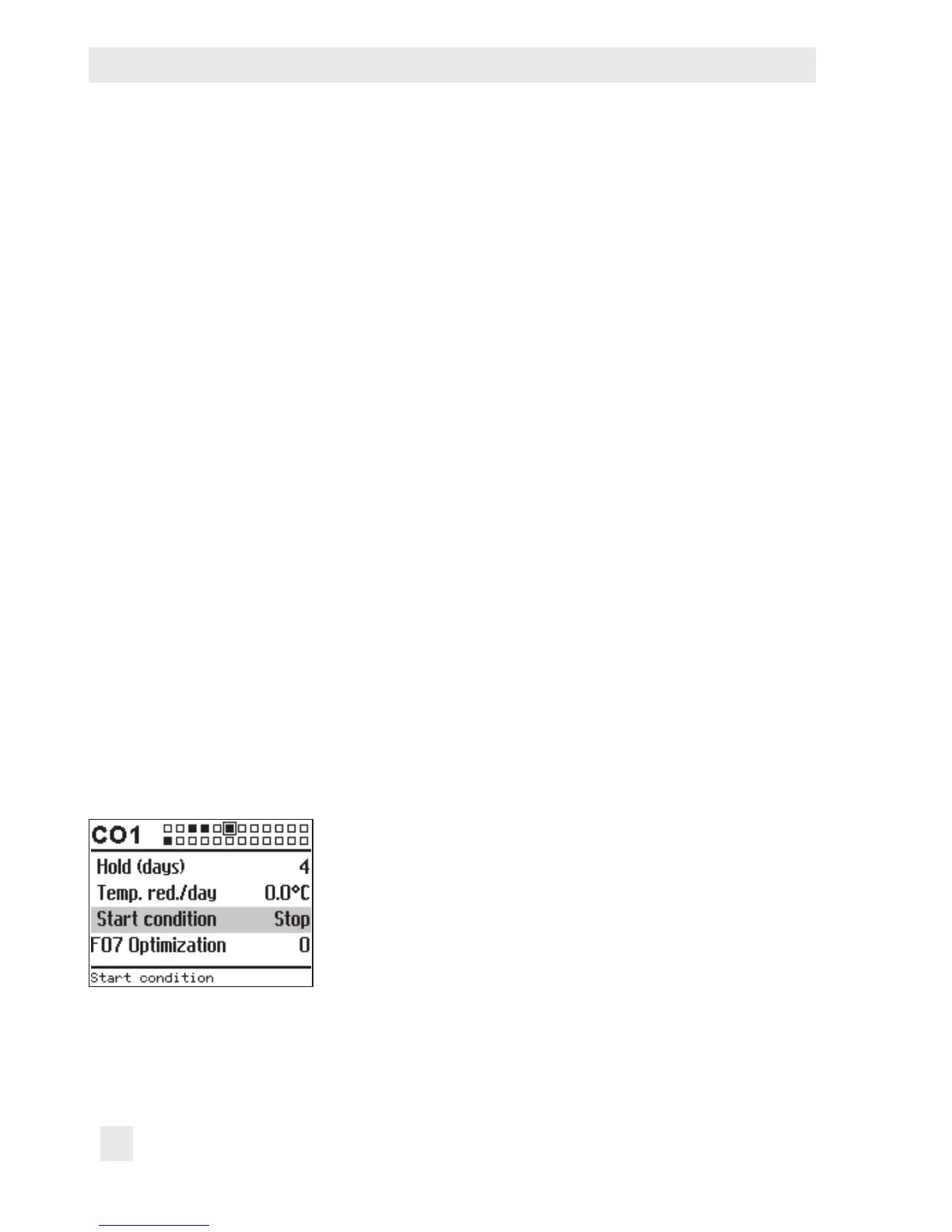
In addition, it is possible to activate the drying of jointless oors function. In connection with
this, the function block parameters are listed which appear after activating this function
block. They determine the drying process: the rst heating up phase starts at the entered Start
temperature, which has a ow temperature of 25°C in its default setting. In the course of 24
hours, this temperature is raised by the value entered in 'Temp. rise/day', i.e. the default set-
ting causes the ow temperature set point to rise to 30°C. If the maximum temperature is
reached, it is kept constant for the number of days entered in 'Duration'. The 'Temp. reduc-
tion/day' parameter determines the temperature reduction downwards. If the 'Temp. reduc-
tion/day' is set to 0, the temperature maintaining phase moves directly to automatic mode. If
the function block parameter 'Start temperature' is set to 25°C and 'Temp. rise/day' to
0.0°C, the drying functions runs as specied in Part 4 of DINEN1264: the drying of joint-
less oors function starts with a ow temperature of 25°C, which is kept constant for three
days. Afterwards, the controller switches to the maximum adjusted temperature. The further
process remains unchanged. The drying of jointless oors function is activated using the ad-
justed 'Start temperature' by changing the setting 'Stop' to 'Start'. 'Start' is displayed when
the drying function starts. The restarting stages 'Hold' and 'Reduction' can be be selected to
continue an interrupted drying process. The course of the drying process can be monitored in
the operating level by reading the measured data of the associated heating circuit.



 To Next Page