2-3
Important User Information Operator Manual 150832-639
2.2 Patient Positioning
and Weight Limitation
NOTE: Accessories may have a specified weight limitation that is less
than that of the table. Do not exceed the lowest weight limit, table or
accessory.
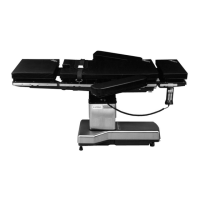
The STERIS 4085 General Surgical Table is designed to safely
support (with patient in normal orientation): 1100 lb (499 kg) without
patient posturing or tabletop slide (except raise/lower); 1000 lb
(454 kg) full patient posturing (except tabletop slide); 600 lb (272 kg)
full patient posturing (including tabletop slide). Do not exceed the
maximum patient weight.
NOTE: When positioning the patient on the table, note the following:
1) Always check patient stability when patient is positioned.
2) Do not place patient on the table unless floor locks are
engaged.
3) Use extreme care when transferring patients to or from table.
4) Ensure all accessories are properly installed and secured.
5) Check for and eliminate harmful patient pressure points once
patient is positioned.
6) Have a qualified medical professional monitor patient during
surgery for all possible patient positioning hazards.
7) Do not place patient upper body weight on the Leg Section.
Leg Section is designed to support leg weight, not body
weight.
All patients must be restrained for proper safety regardless of the
length or type of procedure.
NOTE: STERIS recommends only using STERIS manufactured or
distributed accessories with this table. Use of accessories not
manufactured or approved by STERIS may not be compatible with this
table and could result in injuries or equipment damage.
WARNING – TIPPING
HAZARD:
• Do not place patient on the
table unless floor locks are
engaged.
• Do not use this table for
patients exceeding the
maximum patient weight
(patient in normal
orientation) of 1100 lb
(499 kg) without patient
posturing or tabletop slide
(except raise/lower), 1000 lb
(454 kg) with patient
posturing (except tabletop
slide), or 600 lb (272 kg)
with full patient posturing
(including tabletop slide).
WARNING – PERSONAL
INJURY HAZARD:
• The floor locks must be
engaged at all times when a
patient is on the table.
Failure to engage the floor
locks before placing a
patient on the table or
disengaging the floor locks
while a patient is on the
table could result in the
table rolling unexpectedly
during the procedure.
• Healthcare professionals
must ensure patients are
positioned and monitored
so as to prevent
compromising respiration,
nerve pathways or
circulation
.





 To Next Page