Addressable Fire Panel IRIS - Installation and Programming Manual 5
1. INTRODUCTION
1.1 General Description
IRIS is an analogue addressable re panel with maximum coverage of 96 zones and connecting 1 to 4 loops.
The panel supports two communication protocols: System Sensor series 200/500 (Loop SS) and Teletek
Electronics (Loop TTE) according the type of used devices. In the conguration of the IRIS panel can be
implemented both Loops SS and TTE at the same time.
An arbitrary number of devices can be added to each zone thus ensuring the easy adaptation of the system
to any type of conguration.
To avoid or signicantly diminish problems when mounting the system it must be carefully planned prior to
installation. This includes: establishing an address for every device and planning a name of maximum 40
digits (including the spaces) for each address, thereby ensuring easy access to the device.
According to the acting standards for establishing re systems and the plan of the building, the devices must
be grouped in zones.
Every Loop SS provides up to 99 detectors and 99 modules - “IRIS” Solution.
Every Loop TTE provides up to 250 devices (detectors and modules, regardless of the
type) - “IRIS light” Solution.
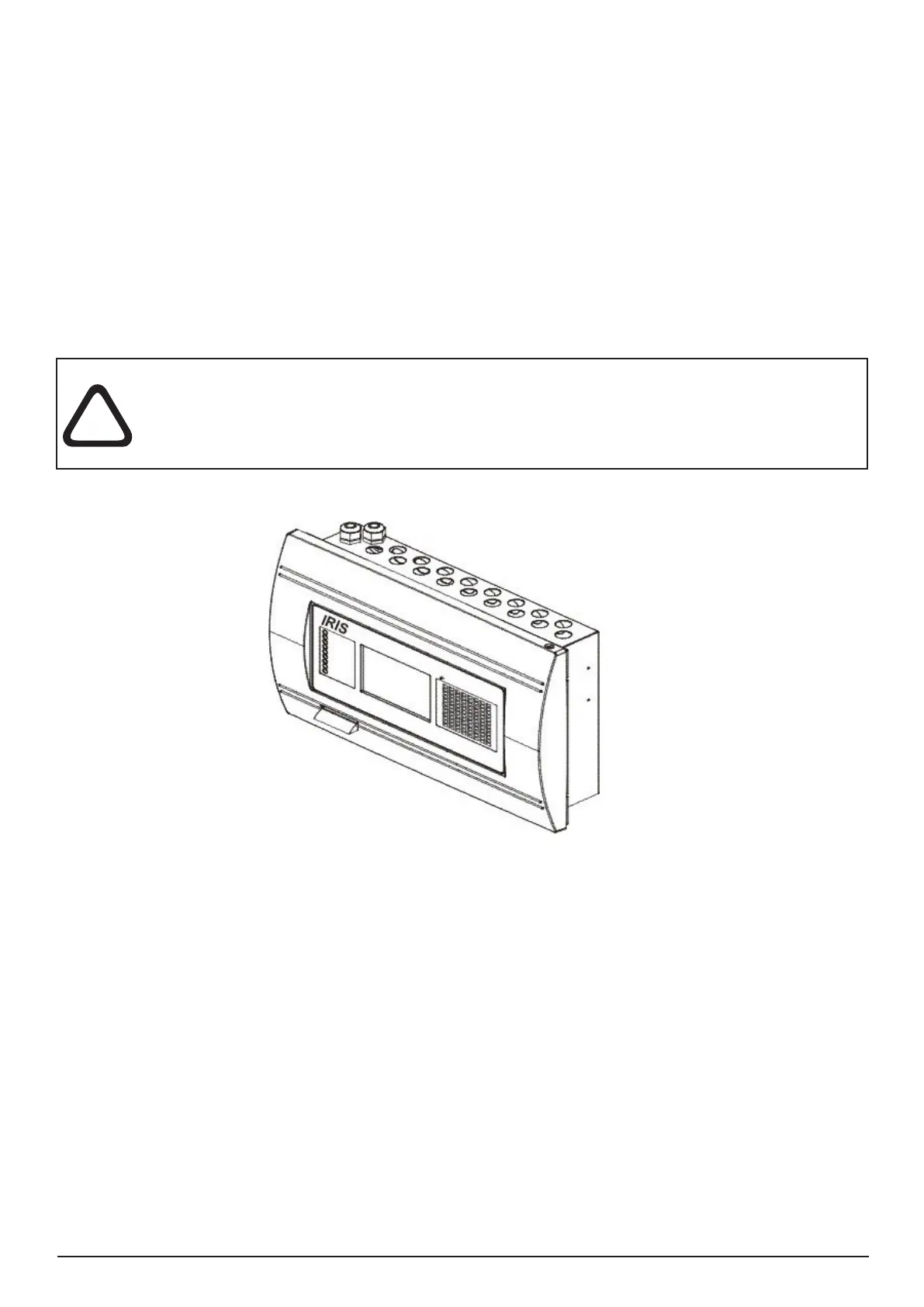
General view of the IRIS Fire Panel
1.2 General Specications
The front panel consists of color graphic LCD display (dimensions 240x320) with a built-in touch screen and
a light-emitting diode indication. Separate operator and engineer passwords provide access to the functions
of the panel. The internal space of the box is protected with the help of secret screws.
Up to four loop controllers, Loop SS and Loop TTE, can be supplemented to the mother board.
The system can be expanded by connecting several re panels IRIS to the Ethernet, using TCP/IP for
communication between them.
The panel has a built-in real time clock and calendar, allowing day and night time modes of work.
Switching over between the two modes can be automatic or manual. Events like FIRE, RESET, FAULT, etc.,
are saved in the memory, thereby creating an event log-le. It contains the time and date, the address of the
device, the type (module or detector), the name of the device, the zone, the name of the zone, etc.


 To Next Page