74 TI-Nspire™ Reference Guide
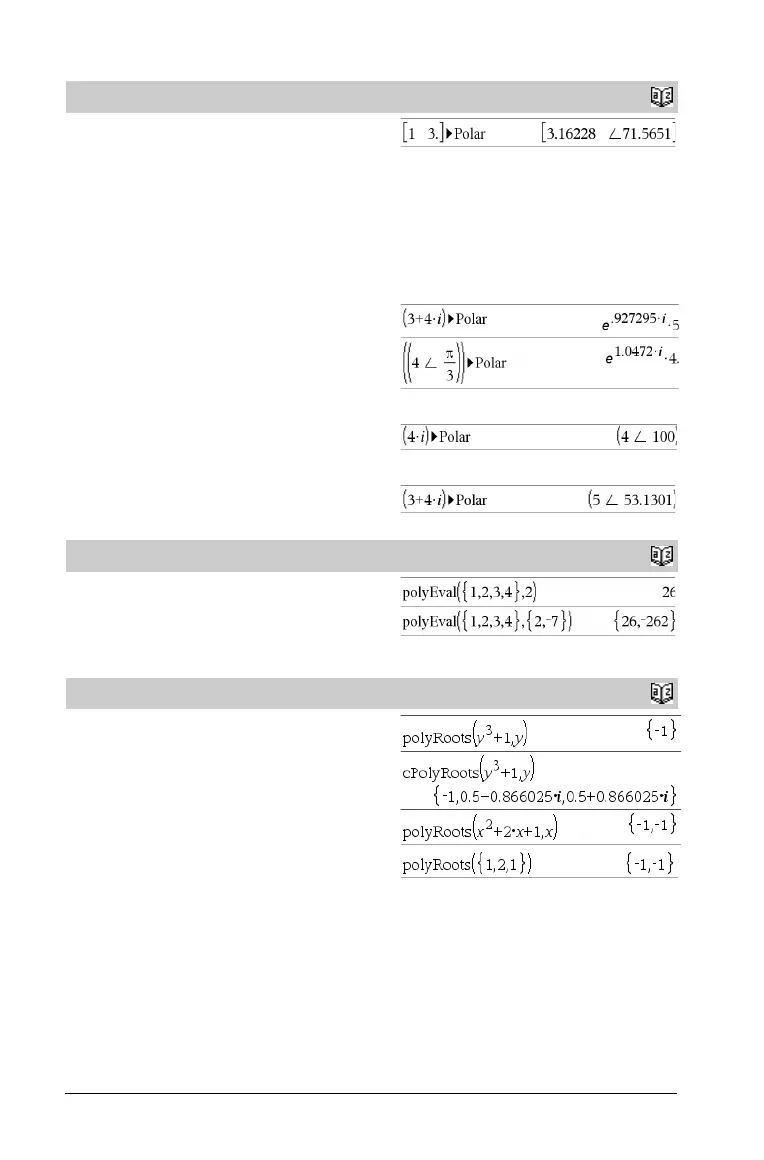
4Polar
Catalog
>
Ve ct or
4Polar
Note:
You can insert this operator from the computer keyboard by
typing @>Polar.
Displays vector in polar form [r
±q]. The vector must be of
dimension 2 and can be a row or a column.
Note: 4Polar is a display-format instruction, not a conversion
function. You can use it only at the end of an entry line, and it does
not update ans.
Note: See also 4Rect, page 81.
complexValue 4Polar
Displays complexVector in polar form.
• Degree angle mode returns (r±q).
• Radian angle mode returns re
iq
.
complexValue can have any complex form. However, an re
iq
entry
causes an error in Degree angle mode.
Note: You must use the parentheses for an (r±q) polar entry.
In Radian angle mode:
In Gradian angle mode:
In Degree angle mode:
polyEval()
Catalog
>
polyEval(List1, Expr1) ⇒ expression
polyEval(List1, List2) ⇒ expression
Interprets the first argument as the coefficient of a descending-degree
polynomial, and returns the polynomial evaluated for the value of the
second argument.
polyRoots()
Catalog
>
polyRoots(Poly,Va r) ⇒ list
polyRoots(ListOfCoeffs) ⇒ list
The first syntax, polyRoots(Poly,Va r ), returns a list of real roots of
polynomial Poly with respect to variable Va r . If no real roots exist,
returns an empty list: { }.
Poly must be a polynomial in expanded form in one variable. Do not
use unexpanded forms such as y
2
·y+1 or x·x+2·x+1
The second syntax, polyRoots(ListOfCoeffs), returns a list of real
roots for the coefficients in ListOfCoeffs.
Note: See also cPolyRoots(), page 23.


 To Next Page
 Loading...