Engine Maintenance
97
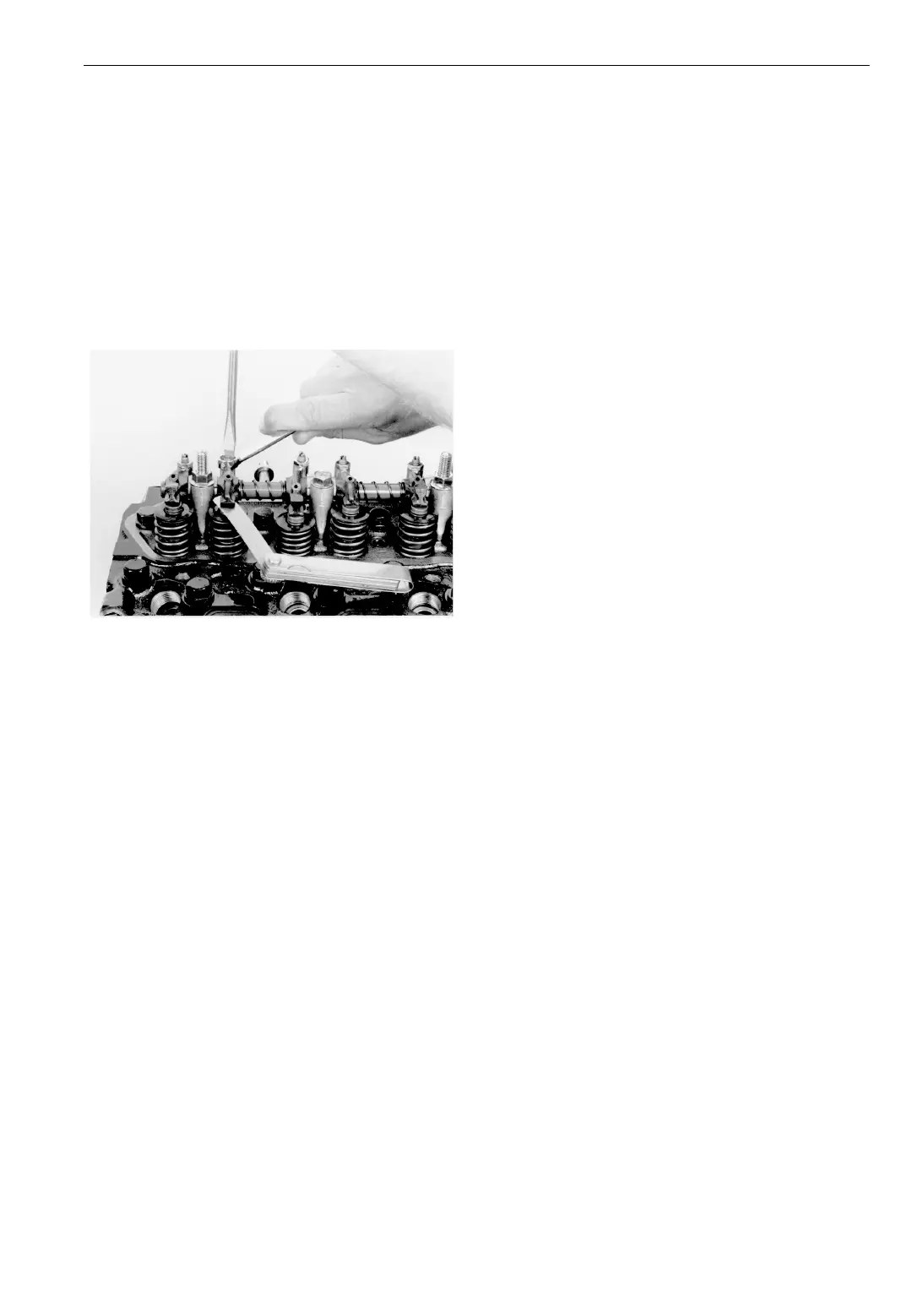
4. Check the valve clearance of both valves for
the number 1 cylinder with a feeler gauge. The
valve clearance for both the intake valve and
the exhaust valve should be 0.006 to 0.010 in.
(0.15 to 0.25 mm).
5. Adjust the valves if necessary by loosening
the lock nut and turning the adjustment screw
until the valve clearance is correct.
6. Hold the adjustment screw in place and
tighten the lock nut.
Figure 50: Adjusting the Valve Clearance
7. Recheck the valve clearance.
8. Rotate the engine in the normal direction of
rotation (counterclockwise from the flywheel
end) until the number 3 cylinder is at top dead
center of the compression stroke.
a. Check the rocker arms and push rods on
the number 3 cylinder.
b. If the rocker arms and push rods are loose,
the number 3 cylinder is at top dead center
of the compression stroke.
c. If the rocker arms and push rods are tight,
the number 3 cylinder is at top dead center
of the exhaust stroke. Rotate the engine
360 degrees to place the number 3 cylinder
at top dead center of the compression
stroke.
9. Check and adjust both valves for the number 3
cylinder.
10. Rotate the engine in the normal direction of
rotation (counterclockwise from the flywheel
end) until the number 2 cylinder is at top dead
center of the compression stroke.
a. Check the rocker arms and push rods on
the number 2 cylinder.
b. If the rocker arms and push rods are loose,
the number 2 cylinder is at top dead center
of the compression stroke.
c. If the rocker arms and push rods are tight,
the number 2 cylinder is at top dead center
of the exhaust stroke. Rotate the engine
360 degrees to place the number 2 cylinder
at top dead center of the compression
stroke.
11. Check and adjust both valves for the number 2
cylinder.
12. Install the rocker arm cover.



 To Next Page