Time Electronics User Manual
5051 Plus and 7051 Plus Multifunction Calibrators v2.1
xx51+ Multifunction Calibrators Page 26 of 64
7.4. AC Voltage
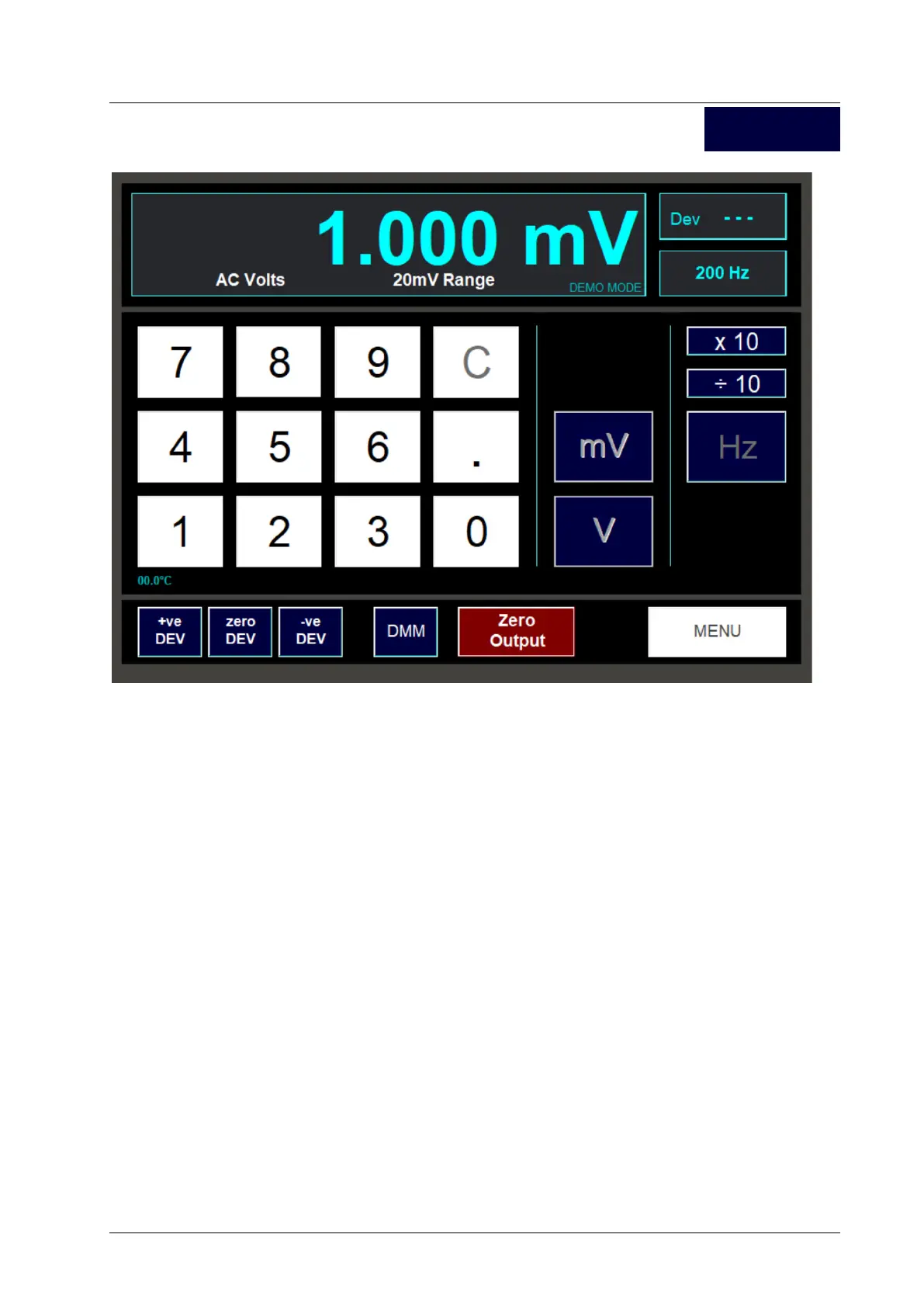
The selection process for AC voltage is identical to DC voltage with an additional option to set the
frequency by using the Hz button (which replaces the +/- button on the DCV screen). After the output
value has been set, the value of the required frequency is input using the digit buttons followed by the
Hz button. The frequency is shown in a window in the top right of the screen.
7.4.1. Frequency Limits
Please note that the allowable frequencies are 10Hz - 20kHz for the 200mV, 2V and 20V ranges, and
40Hz - 1kHz for the 200V and 1 kV ranges.
7.4.2. HV Interlock and Ramping
As with DCV, a safety interlock feature is incorporated to ensure that user must undertake an
additional confirmation when voltages about 40V are selected. Ramping of voltage outputs also
occurs with ACV if the new voltage selected is 100V (or more) different from the present voltage. For
more details on interlock or ramping, see the information in the DCV section.
7.4.3. Low Output Range – 20mV
It should be noted that the xx51, as with other precision AC voltage sources is not able to output
exactly zero. There is always a small residual voltage on the output terminals even when zero is
selected. This is typically 0.6 to 0.9mV. The unit is calibrated to be correct at 2mV (10% of range full-
scale) but should not be used for accurate calibration below this value. If lower values are required, it
is recommended that an external resistive attenuator is used, taking account of the xx51’s output
resistance of 10ohms.
AC V


 To Next Page