Time Electronics User Manual
5051 Plus and 7051 Plus Multifunction Calibrators v2.1
xx51+ Multifunction Calibrators Page 47 of 64
7.9.6. Bandwidth (via fast rise)
The Bandwidth function provides a means for calculating the approximate bandwidth of an
oscilloscope. Selecting this function provides the fast rise-time signal needed for the determination of
a scope’s rise time.
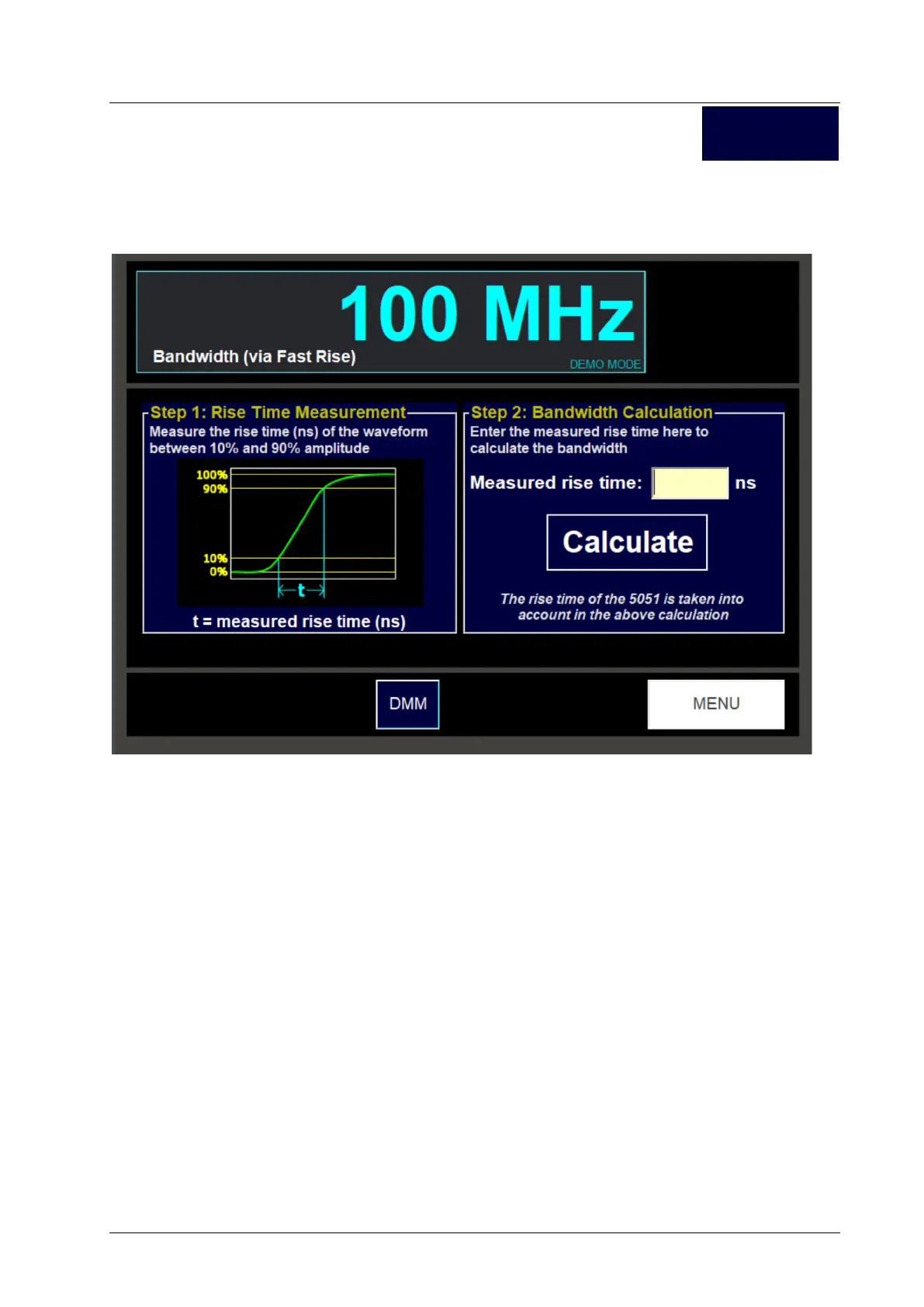
The bandwidth is calculated by first measuring the scope’s displayed rise time using the very fast
rising edge of the xx51’s fast-rise signal. The rise time value is then entered into the control
application and the bandwidth is calculated using a mathematical formula. The result is shown in the
readout at the top of the screen.
It is very important with all scopes to use a 50 ohm terminated input. Some scopes, such as the
LeCroy and most of the Tektronix range have the ability to allow the user to switch in an internal 50
ohm termination. If this is not available, an external 50 ohm through termination - available from Time
Electronics or main line electronics component distributors.
Set the “flat” portions of the waveform on 0% and 100% and measure the 10% to 90% rise time. The
rise time (in nanosec) should be entered into the relevant box on the PC window. Pressing the
Calculate button or hitting the Enter key will show the approximate bandwidth in the main display
window. Note: The bandwidth calculation automatically compensates for the xx51’s signal output rise
time.
Bandwidth
(via fast rise)


 To Next Page