TPT Wirebonder www.tpt.de Page 20 of 53 September 2016
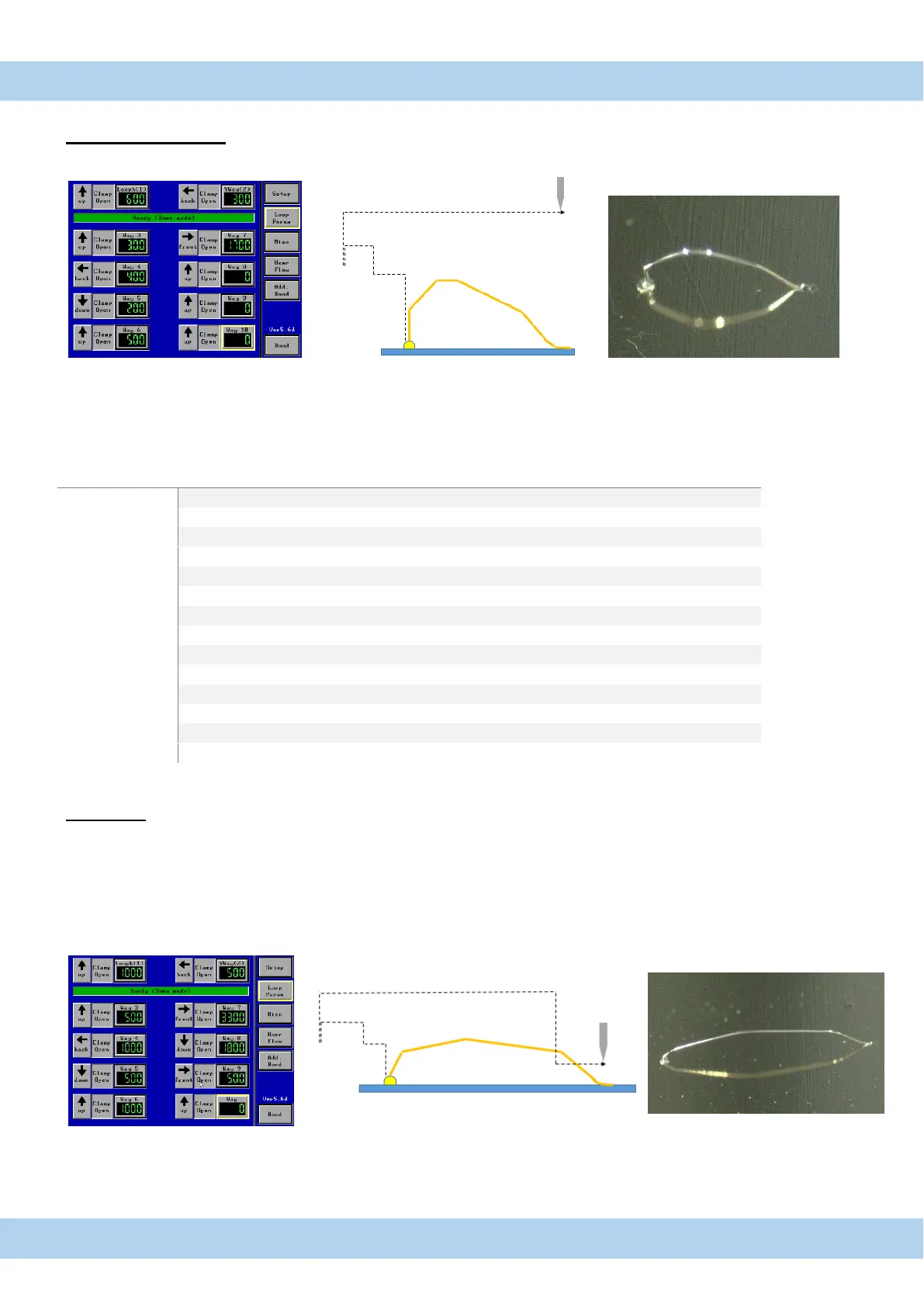
Double Reverse Loop
By adding another 3 steps it is possible to perform the
Double Reverse Loop. This loop is characterized by its curved shape. It is a very stable loop and also lowers the
tension between the ball and the wire. This shape is also suitable for loops with a height gap between bond 1 and
bond 2.
Long Loop
The Long Loop can be performed by moving the capillary downwards and to the front as the last program steps.
This ensures a pulling effect on the bond, performing a long and flat loop. At the same time the added angles
provide stability to the loop. However, the flatness causes tension between the ball and the wire. The flat shape of
the loop is a result of a pulling effect (Way 9) on a very low Z-Level (determined by Way 8). By keeping all values
unchanged and increasing the pulling variable, the loop becomes longer and more flat. If you desire a longer loop
with the same characteristics, please make sure to adjust the other values.
Loop is strained backwards, shorter length
Flat and longer loop, loss of angles
Loop is strained backwards, more wire on same length
Flat loop, loss of angles
Loop is strained backwards, bulbous and shorter loop
Flat loop, more tension between ball and wire
Loop is strained backwards, bulbous loop, loss of angles
Flat loop, loss of angles
Longer loop, tension between ball and wire increases
Loop is strained backwards and shorter



 To Next Page