CVHH-SVX001A-EN 11
Pre-Installation
ASHRAE Standard 15 Compliance
Trane recommends that indoor CenTraVac unit
installations fully meet or exceed the guidelines of the
current version of ASHRAE Standard 15, in addition to any
applicable national, state, or local requirements. This
typically includes:
• A refrigerant monitor or detector that is capable of
monitoring and alarming within the acceptable
exposure level of the refrigerant, and that can actuate
mechanical ventilation.
• Audible and visual alarms, activated by the refrigerant
monitor, inside the equipment room and outside of
every entrance.
• The equipment room should be properly vented to the
outdoors, using mechanical ventilation that can be
activated by the refrigerant monitor.
• The purge discharge and the rupture disk must be
properly piped to the outdoors.
• If required by local or other codes, a self-contained
breathing apparatus should be available in close
proximity to the equipment room.
For the USA, refer to the latest copy of ASHRAE
Standard 15 for specific guidelines. Trane assumes no
responsibility for any economic, health, or environmental
issues that may result from an equipment room’s design
or function.
Unit Shipment
Inspect unit while it is still on the truck for any shipping
damage. The chiller ships shrink-wrapped in a 0.254 mm
(0.010-in.) recyclable film protective covering. Do not
remove shrink-wrap for inspection! Inspect for damage to
the shrink-wrap and determine if physical damage has
occurred.
Each chiller ships from the factory as a hermetically
assembled package; it is factory-assembled, -wired, and
-tested. All openings except for the waterbox vent and
drain holes are covered or plugged to prevent
contamination during shipment and handling.
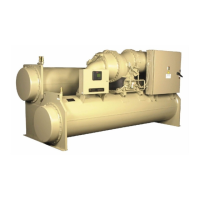
Figure 3,
p. 14
shows an illustration of a typical unit and its
components. As soon as the unit arrives at the job site,
inspect it thoroughly for damage and material shortages.
In addition:
1. Verify the hermetic integrity of the unit by checking the
chiller pressure for an indication of holding charge
pressure.
2. To prevent damaging moisture from entering the unit
and causing corrosion, each chiller is pressurized with
20.7 to 34.5 kPag (3 to 5 psig) of dry nitrogen before
shipment.
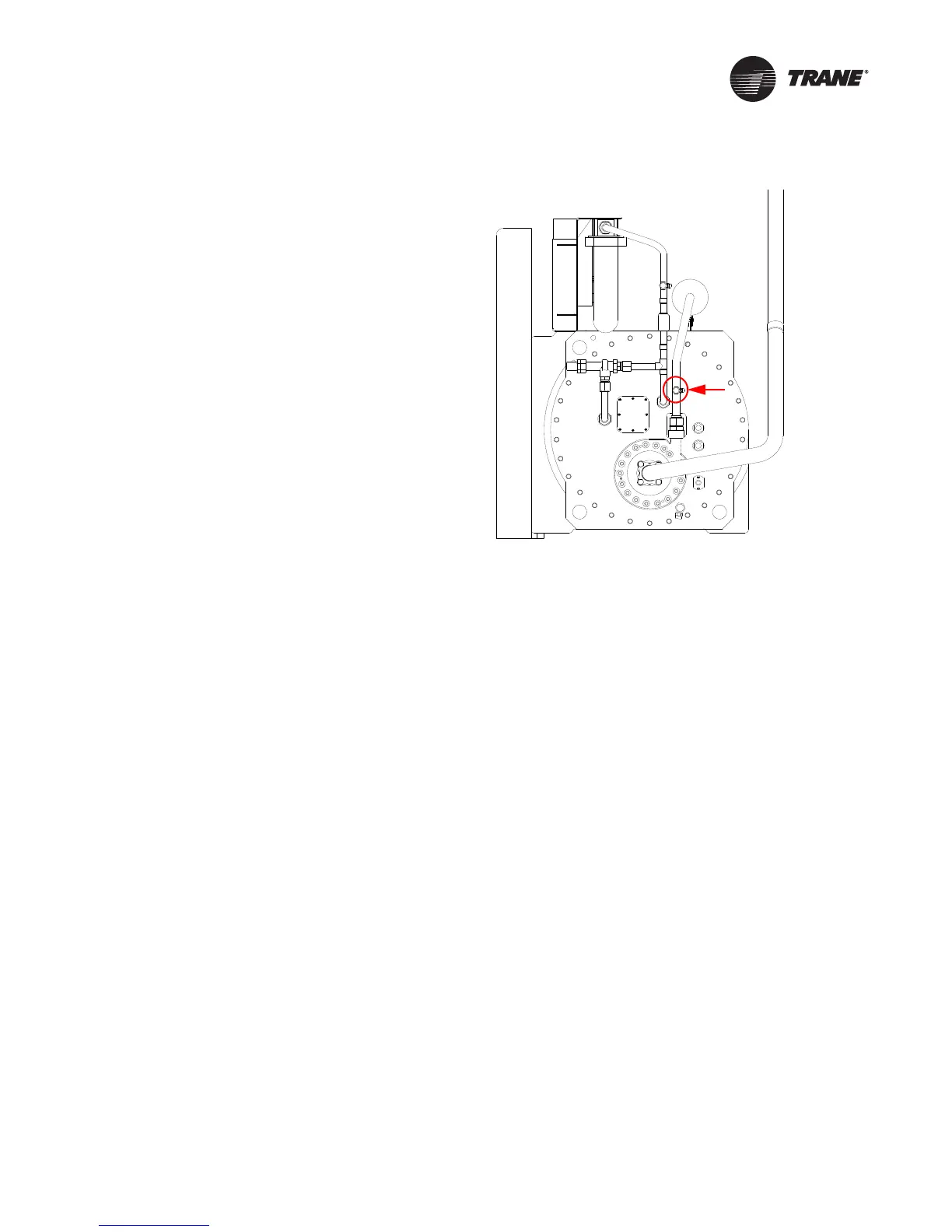
Note: The holding charge should register approximately
34.5 kPag (5 psig) at 22.2°C (72°F). Place a gauge on
the access valve provided (indicated by arrow and
circle in the preceding figure) on the refrigerant
pump discharge line to verify the holding charge.
This access valve is located on the front of the oil
tank, which is at the right rear corner of the chiller.
If the charge has escaped, contact your local Trane
sales office for instructions.
3. The loose parts box and isolator pads ship on top of the
control panel box.
4. Check the oil sum p sight glasses to verify that the sum p
was factory-charged with 79.5 L (21 gallons) of oil. The
oil level should be visible to about halfway in the top
sight glass. If no oil level is visible, contact your local
Trane sales office.
General Information
Regulations regarding waste handling are constantly
changing. To ensure that personnel are in compliance with
the latest federal, state and local regulations, contact your
local waste management office for the proper procedures
on handling, disposal, transporting and storage of oil, oil
filters, refrigerant filters, and filter dryer cores.
Installation Requirements and
Contractor Responsibilities
A list of the contractor responsibilities typically associated
with the unit installation process is provided.


 To Next Page