Power Supply Wiring
CVHH-SVX001A-EN 59
Connect T1 to T6, T2 to T4, and T3 to T5.
Note: Bus bars are not needed in medium-voltage or
high-voltage applications since only 3 terminals
are used in the motor and starter.
Starter to Control Panel Wiring
The unit submittal includes the field wiring connection
diagram and the starter-to-control-panel connection
diagram (showing the electrical connections required
between the remote-mounted starter and the control
panel).
Note: Install separate conduit into the low voltage
(30 volts) section of the control panel.
When sizing and installing the electrical conductors for
these circuits, follow the guidelines listed. Use 14 AWG for
120V control circuits unless otherwise specified. For AWG/
MCM equivalents in mm
2
, refer to
Table 12, p. 47.
Important: Maintain at least 16 cm (6 in.) between low-
voltage (<30V) and high voltage circuits.
Failure to do so could result in electrical
noise that may distort the signals carried by
the low voltage wiring, including the IPC
wiring.
To wire the starter to the control panel, follow the
guidelines below:
• If the starter enclosure must be cut to provide electrical
access, exercise care to prevent debris from falling
inside the enclosure. Do not cut AFD enclosure.
• Use only shielded, twisted-pair wiring for the
Interprocessor Communication (IPC) circuit between
the starter and the control panel on remote mounted
starters.
Note: Recommended wire is Beldon Type 8760,
18 AWG for runs up to 304.8 m (1000 ft). For
AWG/MCM equivalents in mm
2
, refer to
Tab le 12, p. 47. The polarity of the IPC wiring is
critical for proper operation.
• Separate low-voltage (less than 30V; refer to
Tab l e 13,
p. 48
) wiring from the 115V wiring by running each in
its own conduit.
• When routing the IPC circuit out of the starter
enclosure, ensure that it is at least 16 cm (6 in.) from all
wires carrying a higher voltage.
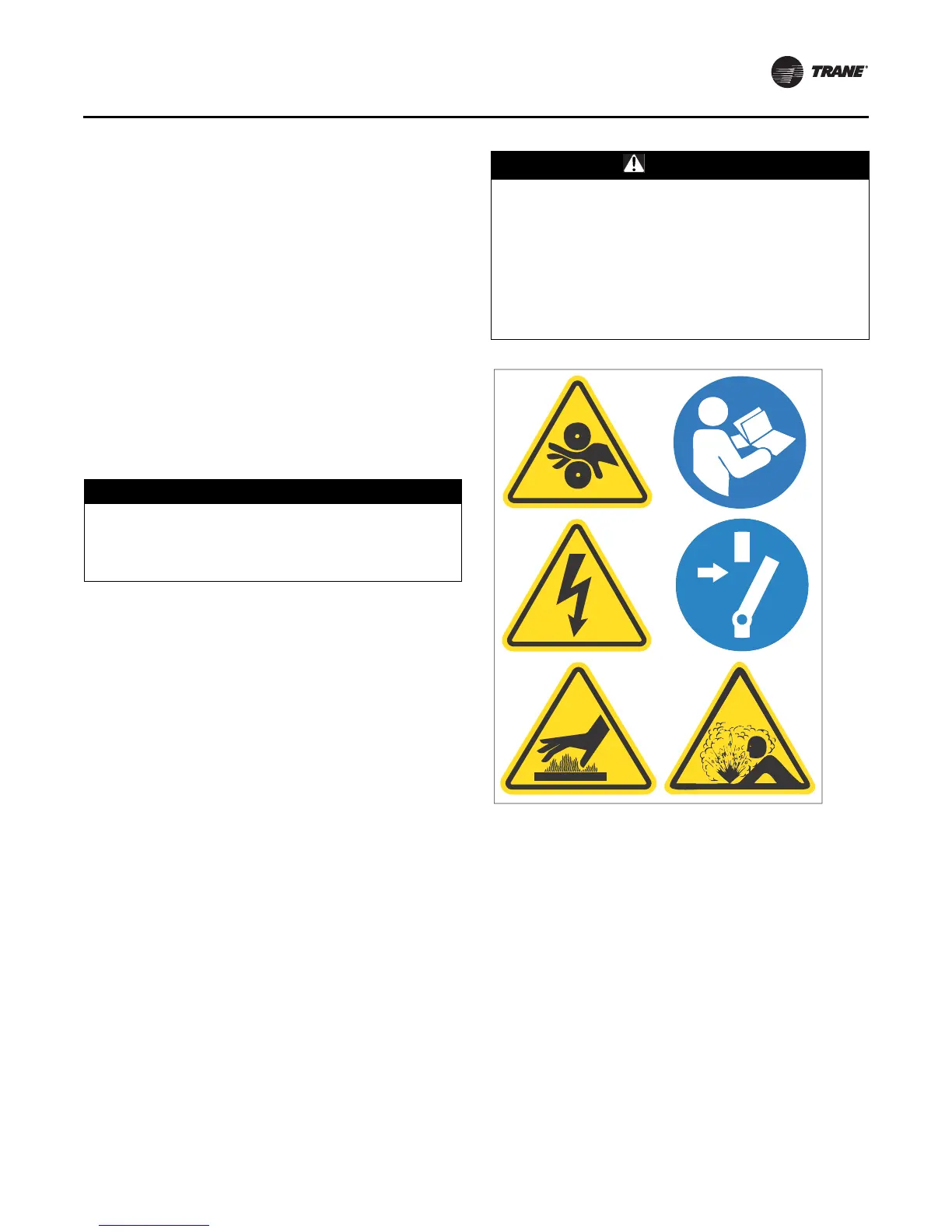
Note: Graphic labels (shown above) are used for CE
application only.
Important:
• Before servicing, disconnect all power sources and
allow at least 30 minutes for capacitors to discharge.
• All electrical enclosures—unit or remote—are IP2X.
• The IPC wiring shield should be grounded on one end
only at control panel end.The other end should be un-
terminated and taped back on the cable sheath to
prevent any contact between shield and ground.
• Oil Pump Interlock: All starters must provide an
interlock (normally open) contact with the chiller oil
pump connected to the control panel at terminals
1X1-10 and 1X1-21 (14 AWG; for AWG/MCM
equivalents in mm
2
, refer to
Table 12, p. 47.) The
purpose of this interlock is to maintain the oil pump
signal in the event that a starter failure, such as welded
contacts, keeps the chiller motor running after the
controller interrupts the run signal.
NOTICE:
Component Damage!
Remove all debris from inside the starter panel. Failure
to do so could result in an electrical short and could
cause serious starter component damage.
WARNING
Proper Field Wiring and Grounding
Required!
Failure to follow code could result in death or serious
injury. All field wiring MUST be performed by qualified
personnel. Improperly installed and grounded field
wiring poses FIRE and ELECTROCUTION hazards. To
avoid these hazards, you MUST follow requirements for
field wiring installation and grounding as described in
NEC and your local/ state/ national electrical codes.


 To Next Page