Recommended Maintenance
96 CVHH-SVX001A-EN
Daily Pumpout Limit to allow the purge to pump out for an
extended period of time.
Once the level of non-condensables present in the chiller
falls to a point in which an increasing am ount of refrigerant
enters the purge tank, the pump-out compressor begins to
cycle on and off. As the refrigerant in the system becomes
less contaminated with non-condensables, purge pump-
out is activated less frequently.
Note: If large amounts of non-condensables are present
in the chiller, the air removal rate can be enhanced
by operating the chiller at part-load conditions.
Leak Testing
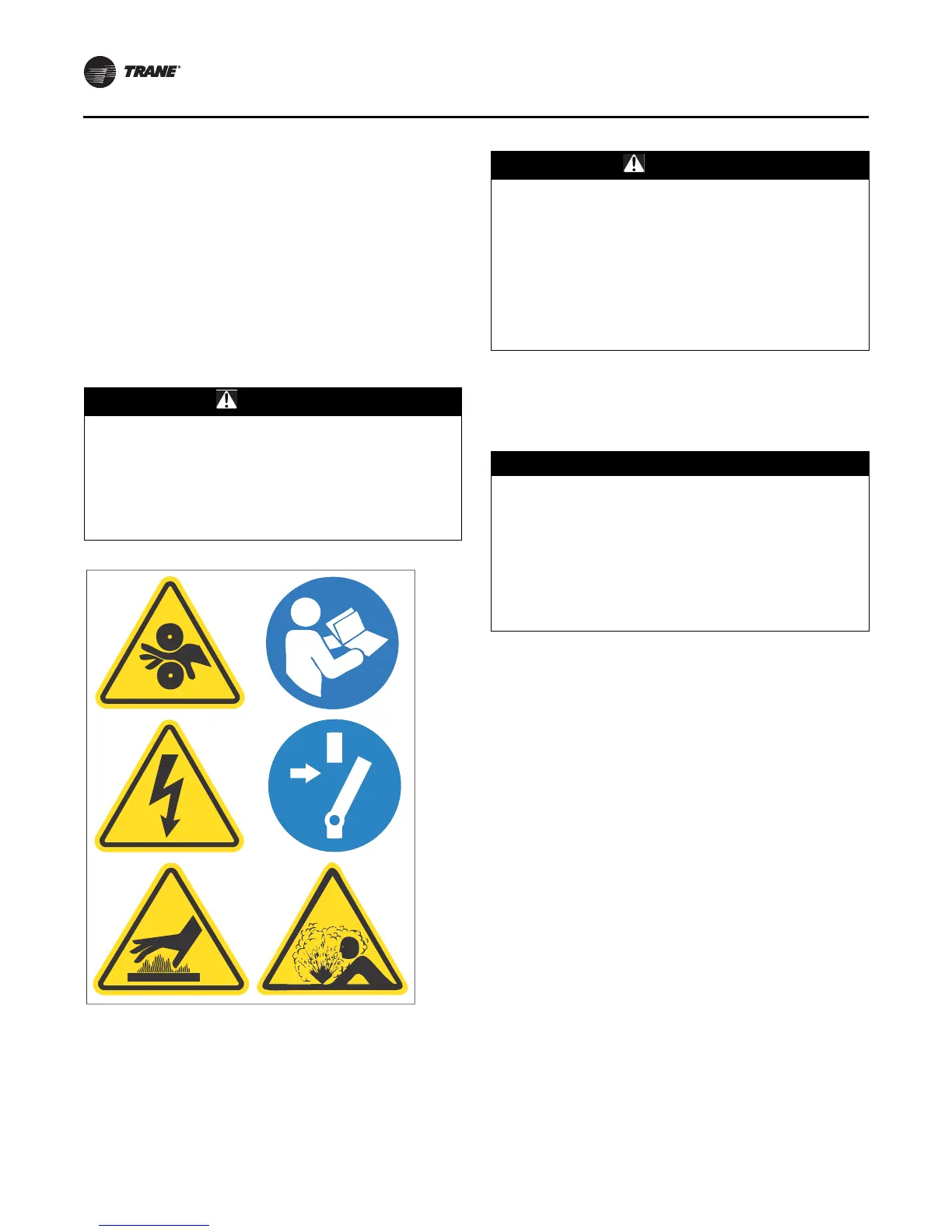
Note: Graphic labels (shown above) are used for CE
application only.
Important: If leak testing is required, contact a Trane
service agency.
Recommended System Maintenance
Condenser
Condenser tube fouling is indicated when the approach
temperature (the difference between the condensing
refrigerant temperature and the leaving condenser water
temperature) is higher than predicted.
If the annual condenser tube inspection indicates that the
tubes are fouled, two cleaning methods, mechanical and
chemical, can be used to rid the tubes of contaminants.
Use the mechanical cleaning method to remove sludge
and loose material from smooth-bore tubes.
To clean other types of tubes including internally-
enhanced types, consult a qualified service organization
for recommendations.
WARNING
Hazard of Explosion!
Failure to follow recommended safe leak test
procedures could result in death or serious injury or
equipment or property-only-damage. Never use an
open flame to detect gas leaks. Explosive conditions
may occur. Use a leak test solution or other approved
methods for leak testing.
WARNING
Hazardous Pressures!
Failure to follow these safety precautions could result
in a sudden rise of pressure possibly resulting in a
violent explosion which could result in death or serious
injury. If a heat source is required to raise the tank
pressure during removal of refrigerant from cylinders,
use only warm water or heat blankets to raise the tank
temperature. Do not exceed a temperature of 150°F. Do
not, under any circumstances apply direct flame to any
portion of the cylinder.
NOTICE:
Proper Water Treatment!
The use of untreated or improperly treated water in a
CenTraVac could result in scaling, erosion, corrosion,
algae or slime. It is recommended that the services of a
qualified water treatment specialist be engaged to
determine what water treatment, if any, is required.
Trane assumes no responsibility for equipment failures
which result from untreated or improperly treated
water, or saline or brackish water.


 To Next Page