June 11, 2015, 715004754 Rev. A
Page 31
• CPU board – Contains the digital signal processor, communication ports,
nonvolatile (battery backup) RAM, and flashable RAM space, for firmware.
• Personality board – Provides the interface between the analog input signals from
the optics and the microprocessor, for further signal conditioning. The board
generates analog output signals, drives the LED, Autozero, and signal
compensation electronics, and stores and executes input from the front-panel
keypad and the rear-panel contact closures. Finally, the personality board
provides communication between the 2414 RI detector and external devices
through the Ethernet, IEEE-488 interface, and terminal strip input/output
connections.
• Front-panel board – Controls the keypad, indicators, and display.
• Ethernet communications interface – Allows the detector to communicate with a
data control system, such as Empower software or MassLynx software, via its
Ethernet connector.
• IEEE-488 communications interface – Allows the detector to communicate with
the chromatography data control software or Alliance system via its IEEE-488
connector.
• Keypad – Allows you to access the control system, program methods, configure,
and troubleshoot the detector.
• dc power supply – The power source for the detector, the dc power supply
provides voltage for the analog and digital circuitry.
1.3.7.1 Filter noise
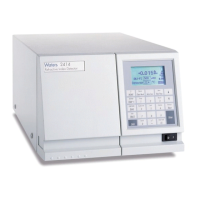
The 2414 RI detector uses a Hamming filter and RC filter to minimize noise.
1.3.7.1.1 Hamming filter
A hamming filter is a digital, finite impulse response (FIR) filter that creates the same
amount of peak height attenuation as the RC filter but enhances the filtering of high
frequency noise. This filter is available as the default setting RIU mode, but is not
available in 410 mode.
The behavior of the filter depends on the time constant that you select: fast, slow,
normal, or other. If you select Fast, Slow, or Normal time constant, you need not
specify a value. The filter constant is determined by the sampling rate. If you select
Other, you can specify a value. However, that is rounded up or down, to a value based
on the sampling rate.
The filter’s time constant adjusts the duration over which the data are filtered, thus
controlling the degree of baseline smoothing and the impact on peak height
degradation. Optimizing this parameter in the method ensures the highest
signal-to-noise ratios are achieved for a particular application.
Decreasing the time-constant settings produces these effects:
• Narrow peaks, with minimal peak distortion and time delay.
• Very small peaks, which are difficult to discriminate from baseline noise.
• Less baseline noise is removed.


 To Next Page