June 11, 2015, 715004754 Rev. A
Page 32
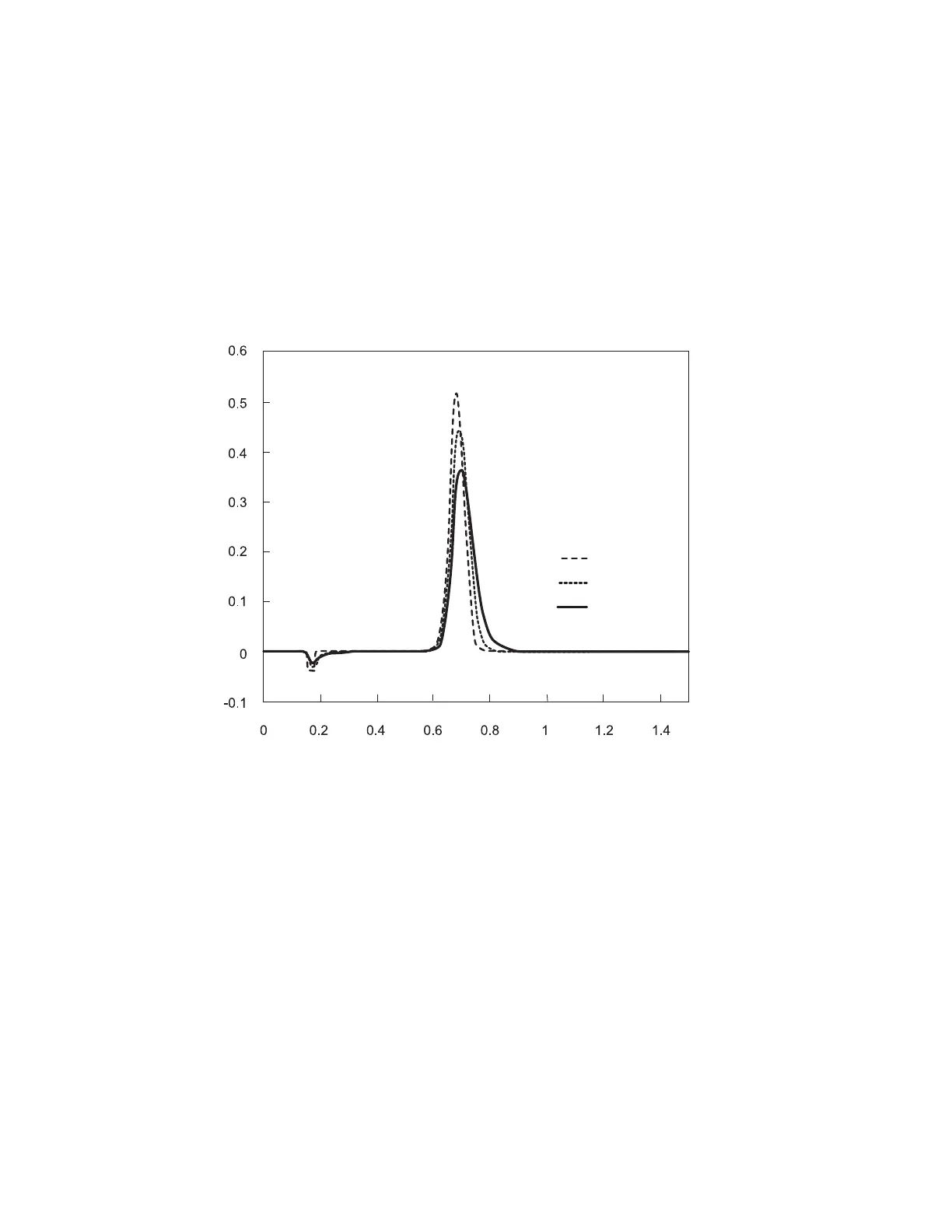
Increasing the time-constant settings produces these effects:
• Greatly decreased baseline noise.
• Shortened and broadened peaks.
The software includes fast or normal filtering constants at each sampling rate that are
appropriate for high speed or high sensitivity applications, respectively.
The following figure shows the relationship between increased filter time constant and
absorbance.
Figure 1–10: Filter time constant comparison
1.3.7.1.2 RC filter
A finite impulse response filter, which simulates a first-order resistor and capacitor
filter. This filter is available in 410 mode. The performance of the filter depends on the
time constant that you select. The filter time constant adjusts the filter’s response to
achieve an optimal signal-to-noise ratio.
Lower time-constant settings produce these effects:
• Remove less baseline noise
• Narrow peaks, with minimal peak distortion and time delay
• Very small peaks, which are difficult to discriminate from baseline noise


 To Next Page