November 16, 2016, 715004521 Rev. C
Page v
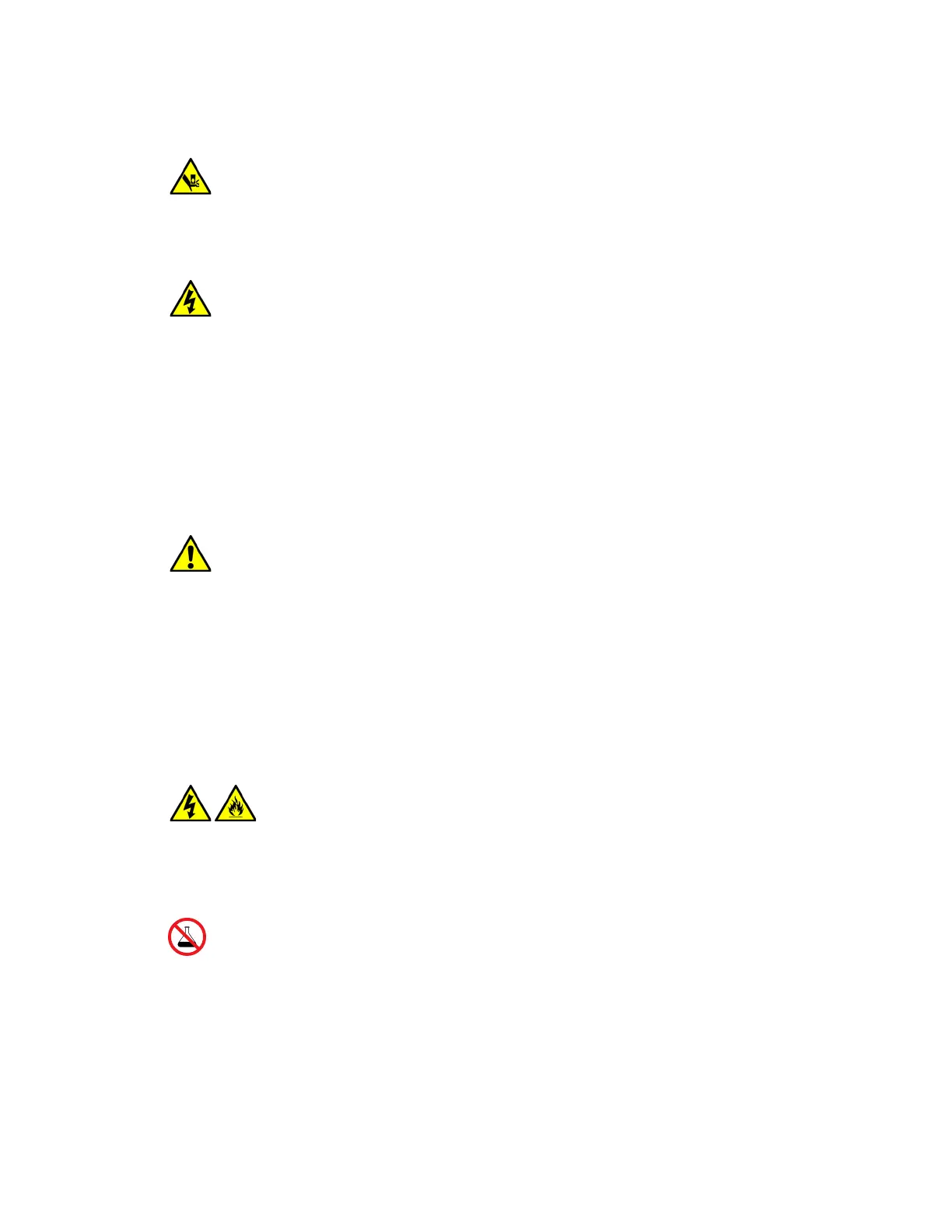
Hand crush hazard
High voltage hazard
Carbon dioxide hazards to humans
Carbon dioxide exhibits three primary hazards for humans:
• Toxicity at levels above 10,000 ppm (PEL 5000 ppm).
• Frostbite from uncontrolled release of pressurized CO
2
to atmosphere or contact
with accumulated dry ice at a leak site.
• Asphyxiation caused by the displacement of oxygen.
Before proceeding with any monitoring safety configuration, consult with your
environmental health and safety manager regarding applicable local, federal, and
international safety regulations and requirements.
Bottle placement prohibition
FCC radiation emissions notice
Changes or modifications not expressly approved by the party responsible for compliance, could
void the users authority to operate the equipment. This device complies with Part 15 of the FCC
Rules. Operation is subject to the following two conditions: (1) this device may not cause harmful
Warning: To avoid crushing your fingers beneath or between modules, use extreme care
when installing a module in the system stack.
Warning: To avoid electric shock, do not remove protective panels. The components they
cover are not user-serviceable.
Warning: To prevent injury or death, install a CO
2
Ambient Air Sensor/Alarm unit
to ensure compliance with OSHA PEL for CO
2
in locations where CO
2
is used or
stored, instead of or in addition to, an oxygen monitor. Monitors must be
capable of detecting CO
2
levels at a minimum of 5000 ppm or as required by
your local regulating agency.
Warning: To avoid injury from electrical shock or fire, and damage to the equipment, do not place
vessels containing liquid atop the workstation or ancillary equipment or otherwise expose those
units to dripping or splashing liquids.
Prohibited: Do not place vessels containing liquid—such as solvent bottles—atop the
workstation or ancillary equipment or otherwise expose those units to dripping or splashing
liquids.










 To Next Page